

TraderVue is one of the longest-standing trading journal platforms, known for its structured reporting, trade tagging, and historical performance analysis. Many traders use it to review execution quality, track strategy performance, and build consistency over time without relying on overly complex dashboards.
That said, TraderVue isn’t the only option in this space. Other platforms approach journaling with different priorities, such as deeper analytics, visual dashboards, automation, or educational support.
Below are some of the most relevant TraderVue alternatives, each offering a distinct take on trade tracking and performance review.
Best TraderVue Alternatives
These tools all support trade journaling at a core level, but differ in how much flexibility, depth, and guidance they provide.
1. TradeZella
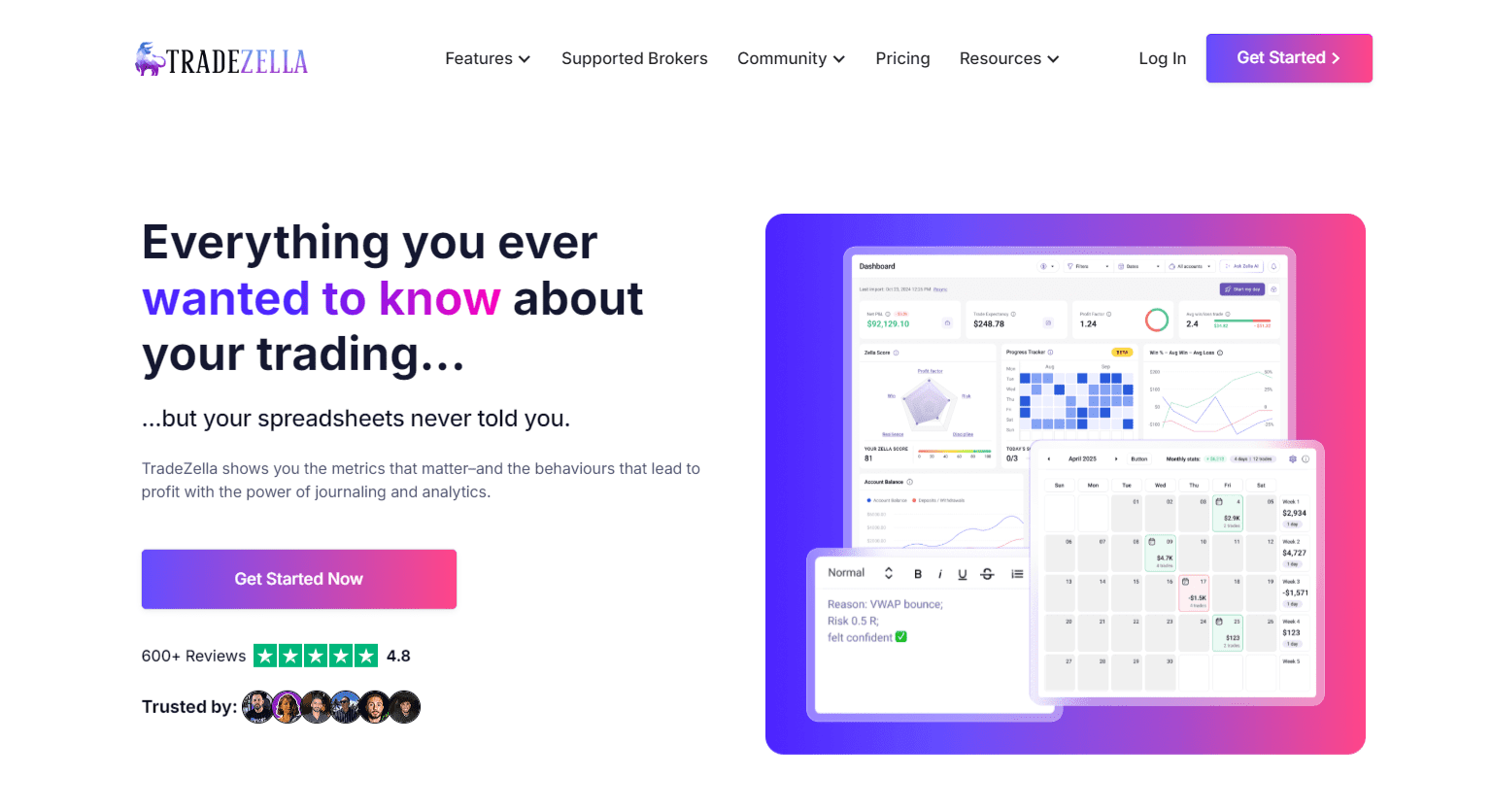
TradeZella focuses on clean visualization and structured summaries that help traders quickly understand their performance. Its interface emphasizes clarity, with dashboards designed to highlight patterns, strengths, and recurring mistakes without overwhelming users with raw data.
Compared to TraderVue, TradeZella leans more heavily into visual storytelling. Instead of dense tables and reports, it presents metrics in a way that’s easier to scan and interpret.
This can be especially helpful for traders who want quick feedback after sessions rather than deep statistical breakdowns.
✅ Pros
- Clean, modern interface with strong visual summaries
- Easy to navigate dashboards
- Good balance between journaling and performance review
❌ Cons
- Less customization than advanced analytics platforms
- Power users may want more granular control over metrics
TradeZella typically operates on a subscription model with tiered access, making it suitable for traders who value usability and presentation as much as data.
2. TraderSync
TraderSync positions itself as a flexible alternative that blends journaling with performance metrics. It supports automated trade imports, tagging by strategy or setup, and performance breakdowns that help traders identify trends across assets and timeframes.
Relative to TraderVue, TraderSync offers a more streamlined workflow. It’s designed to reduce friction during trade review while still providing enough depth to support ongoing improvement.
Many traders choose TraderSync when they want structured analysis without committing to highly complex dashboards.
✅ Pros
- Automated imports reduce manual logging
- Balanced mix of usability and analytics
- Clear performance summaries
❌ Cons
- Analytics depth may feel limited for advanced users
- Interface prioritizes function over visual flair
TraderSync’s pricing is tier-based, with higher plans unlocking more advanced features and data capacity.
3. Trademetria
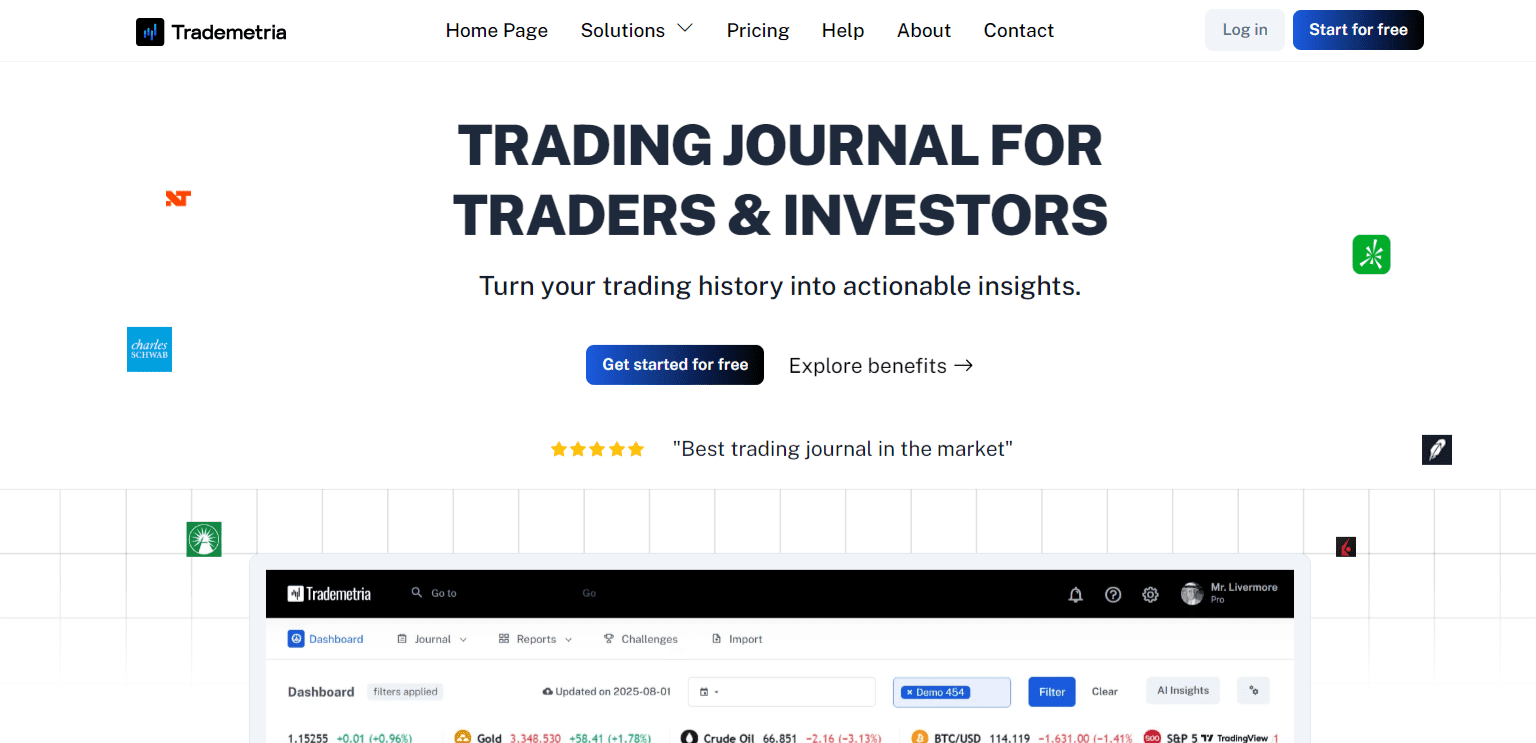
Trademetria takes a more straightforward approach to trade journaling. It focuses on logging trades accurately, tracking performance, and generating reports that summarize results without extensive customization.
When compared to TraderVue, Trademetria emphasizes organization and routine review over analytics experimentation.
Its interface is structured and practical, appealing to traders who want consistency and clarity rather than visual dashboards or deep metric configuration.
✅ Pros
- Clear, structured journaling workflow
- Transparent, publicly listed pricing
- Easy to adopt for routine trade tracking
❌ Cons
- Limited advanced analytics
- Fewer customization options
Trademetria is often chosen by traders who value predictability and simplicity in their journaling process.
4. TradesViz
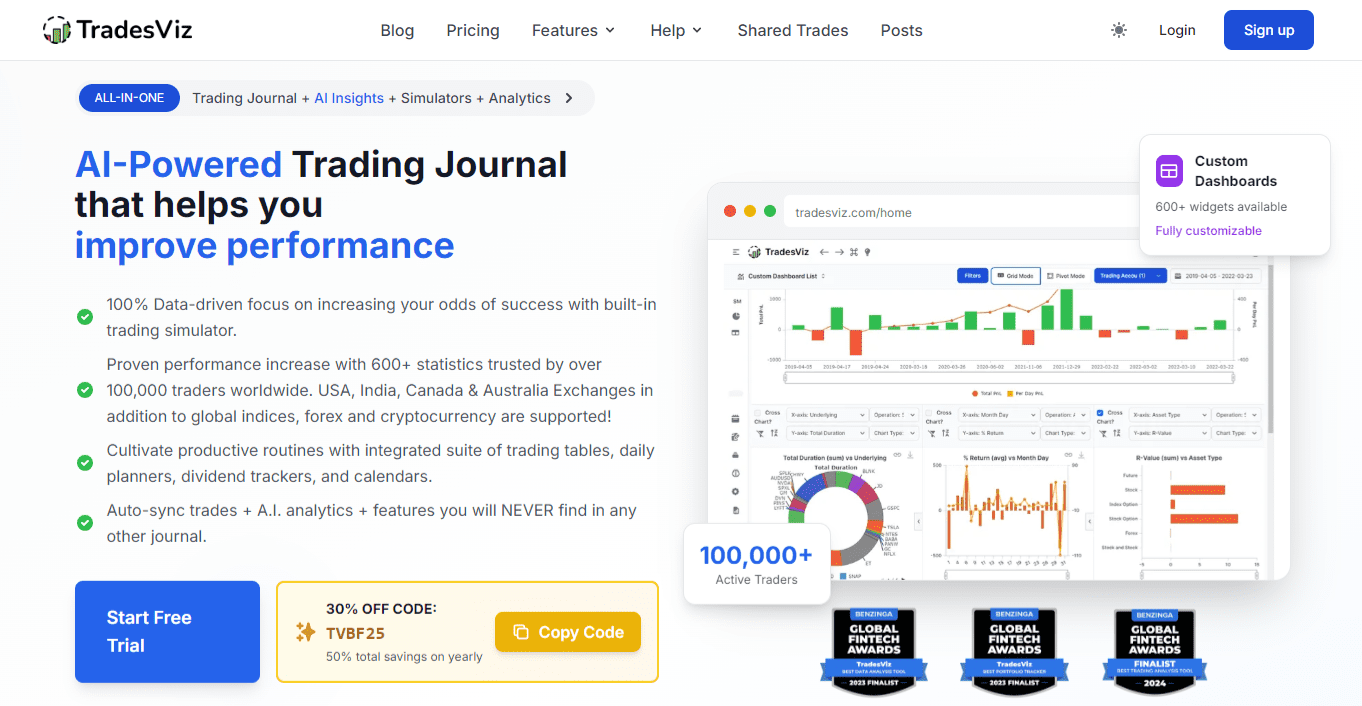
TradesViz is built for traders who want maximum control over their data. It goes well beyond basic journaling by offering customizable dashboards, advanced analytics, and simulation tools across multiple asset classes.
Compared to TraderVue, TradesViz delivers significantly more analytical depth. Traders can configure how data is displayed, compare performance across strategies, and explore metrics in granular detail.
This makes it appealing to experienced traders who rely heavily on data-driven decision-making.
✅ Pros
- Extremely deep analytics and customization
- Supports multiple asset classes
- Advanced visualization and simulation options
❌ Cons
- Steeper learning curve
- Can feel overwhelming for newer traders
TradesViz uses subscription plans that scale with feature access, reflecting its focus on advanced functionality rather than simplicity.
5. EdgeWonk
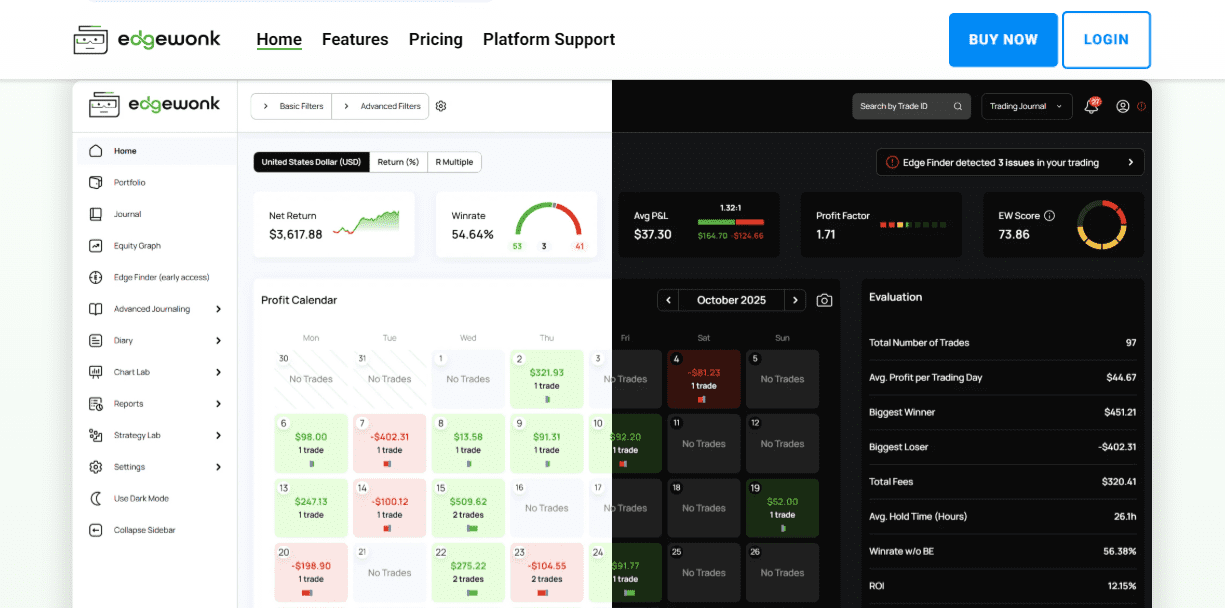
EdgeWonk is positioned as a professional-grade trading journal with a strong educational angle.
In addition to trade tracking, it emphasizes discipline, self-analysis, and long-term improvement through structured journaling practices.
Compared to TraderVue, EdgeWonk places more focus on the psychological and process-driven side of trading.
It encourages traders to document decision-making, review behavior patterns, and refine execution habits over time.
This makes it particularly attractive to traders who see journaling as a core part of their trading education.
✅ Pros
- Strong focus on discipline and trading psychology
- Supports multiple asset classes
- Designed for long-term performance improvement
❌ Cons
- Interface is more functional than modern
- Less emphasis on visual dashboards
EdgeWonk is offered as a paid product with full feature access included, aligning with its positioning as a comprehensive journaling solution rather than a lightweight tracker.
Frequently Asked Questions
Are TraderVue Alternatives Suitable for Active Day Traders?
Yes. Most of these platforms support frequent trade logging and performance review, though their analytics depth varies.
Do All TraderVue Alternatives Support Automated Imports?
Most do, but the number of supported brokers and data depth can differ between platforms.
Is a More Advanced Journal Always Better?
Not necessarily. The best journal is one that matches a trader’s workflow and is used consistently.
Can Traders Switch Journals Without Losing Historical Data?
In many cases, historical trades can be exported and re-imported, though the process depends on the platform.
Conclusion
TraderVue remains a reliable choice for traders who want structured reporting and historical performance analysis.
However, alternatives like TradeZella and TraderSync emphasize usability and workflow efficiency, while TradesViz caters to traders seeking advanced analytics and customization.
Trademetria appeals to those who prefer simplicity and transparent pricing, and EdgeWonk stands out for its focus on discipline, education, and process improvement.
The right alternative depends on whether a trader prioritizes visuals, analytics depth, routine structure, or psychological development.