


Prop firm marketing is mostly about profit splits. The rules that decide whether you ever reach a split get less attention, which is backwards, because those are the ones that end most attempts.
10FOUR publishes its account parameters openly on the buying page, so it is possible to work out what you are agreeing to before spending anything. This review goes through them in the order that actually matters.
Worth Knowing: nothing measures the smallest Instant account day by day, a 25% consistency requirement applies at every size, and $500 is the payout floor whatever you hold.
Rule One: What Can Fail You

Two numbers govern the Instant accounts, and on the smallest size there is only one. At $25K there is a single ceiling, $1,000 of total loss, and nothing measuring you day by day.
From $50K upward a daily figure appears: $1,200 on the $50K, $2,100 on the $100K and $3,000 on the $150K, sitting under maximum losses of $2,000, $3,500 and $5,000 respectively.
That inversion is worth thinking about. On most account ladders the constraints tighten as the capital grows in proportional terms.
Here the entry account is the one with the fewest ways to breach, which makes it a sensible place to learn the platform even if you can afford more.
Rule Two: The Consistency Requirement
Twenty-five percent applies to every size, and consistency rules are where a good run quietly fails to convert.
The principle across the category is that no single day should account for too large a share of the profit behind a payout.
At a quarter, that means a genuinely outsized session needs balancing with other profitable days before the money becomes withdrawable.
For a trader who takes several moderate trades a week this is close to invisible. For someone whose edge produces one large day a month, it is the rule that decides whether they get paid, and it deserves reading before the profit split does.
Rule Three: Position Limits
Contract caps scale cleanly with size: 2 minis or 20 micros at $25K, 4 or 40 at $50K, 6 or 60 at $100K, and 10 or 100 at $150K.
The micro allowance is the useful part of that. Trading micros within a 20-contract ceiling gives fine control over position sizing on a small account, which pairs well with the absence of a daily loss limit at that tier.
Rule Four: Getting Paid
Three things govern this, and 10FOUR has made all three unusually favourable.
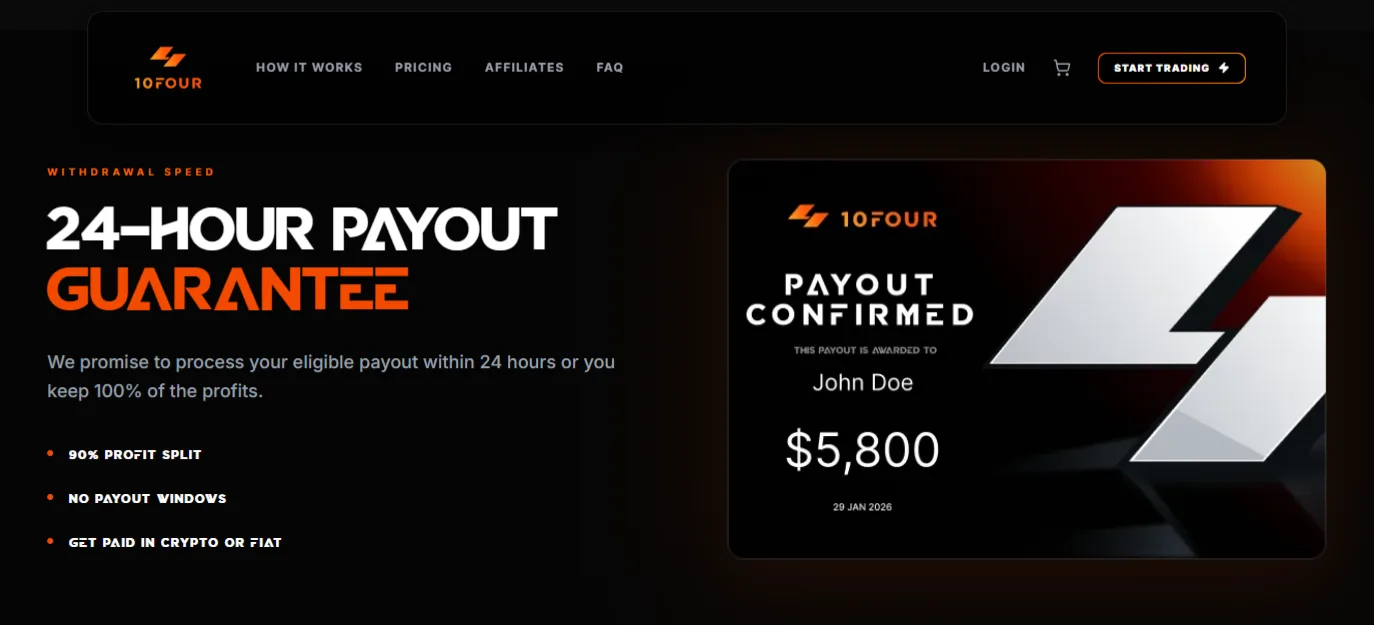
Ninety percent is your share. Five hundred dollars is the floor for a request, whatever size account you hold. And nothing schedules when you may ask, so the moment you qualify you can submit.
Layered above that is the undertaking itself. Process an eligible request inside a day, or the share moves to the full hundred percent.
That is the sentence I would weigh most heavily, because it is the only commitment on the page that costs the firm money if it is not honoured.
Payment arrives in crypto or fiat.
What It Costs to Start

| Size | List price | With the current code |
| $25K | $342.86 | $240 |
| $50K | $521.43 | $365 |
| $100K | $700 | $490 |
| $150K | $842.86 | $590 |
One payment, no subscription. The firm’s stated reasoning for that structure is that recurring billing pushes traders into overtrading to beat the cycle, and that one-off pricing keeps the pressure off while obliging the company to earn every new sale.
Instant is one of three routes. Origin and Daily are the alternatives, so the size decision comes after choosing which evaluation style suits you.
The Small Print Worth Reading
The self-description is precise: a platform for education, for assessing skill and for measuring performance.
It states equally plainly what it is not, ruling out any status as broker, investment house or provider of financial services.
Both the evaluation and the simulated funded stage operate on fictitious money, and you hold no ownership stake in any balance shown. Any move onto live capital is theirs to grant.
Rewards are framed as discretionary and performance-based, not as guaranteed income or a return on investment. Ten Four Group, registered in Hong Kong, is the operating entity.
The tradeable universe is futures listed across four exchanges, CBOT, NYMEX, COMEX and CME, taking in agricultural and metals contracts as well as energy, currencies and equity index products.
My Read
A good fit for traders who dislike recurring fees and want to know the rules before committing.
Everything that decides an outcome is published on the buying page rather than discovered later, and the entry account’s lack of a daily limit makes it a forgiving place to start.
Think carefully if your profits arrive in bursts. The 25% consistency requirement applies at every size, and a single dominant day will need company before a payout clears.
What I keep returning to is the payout guarantee. Firms in this category compete on advertised speed constantly.
Attaching a cost to missing the deadline, in the form of a full profit split, is a different kind of promise, and it is the detail I would want anyone comparing options to notice.
Frequently Asked Questions
What Are 10FOUR’s Account Rules?
Instant accounts carry a maximum loss of $1,000, $2,000, $3,500 or $5,000 by size, daily limits of none, $1,200, $2,100 and $3,000 respectively, a 25% consistency rule throughout, and position caps rising from 2 minis to 10.
Is Any Account Free Of A Daily Cap?
The $25K Instant is. A $1,000 total-loss ceiling is the only thing governing it.
What Is The Minimum Payout?
$500, applied uniformly across every account size, with no payout window restricting when you can request it.
What Happens If A Payout Is Late?
The firm states that if an eligible payout is not processed within 24 hours, your profit split increases to 100%.
Are There Recurring Charges?
No. Accounts are one-time purchases, which the firm presents as a deliberate alternative to monthly billing.
Is 10FOUR Trading Real Money?
Both stages run on fictitious money, and no ownership stake attaches to any balance displayed. Whether you ever reach live capital is theirs to decide.