


Prediction market funding is about a year old as a category, and it shows. The five firms below do not agree on what the product even is.
Two fund you on Polymarket after a paid evaluation, one hands you a free account to start, and one runs it as a competition where the prize is a forex challenge.
That spread makes the usual comparison useless. Fee and split tell you little. What separates these firms is what can fail you, what you may trade, and what you walk away with.
By the Numbers: Entry runs free to $535. Targets run 6% to 30%. Daily loss limits run $20 to none at all. Splits run 70/30 to 90/10, and one firm charges extra for the better half.
Top 5 Prediction Market Prop Firms
Let’s take a look at this list.
1. Funding Predicts
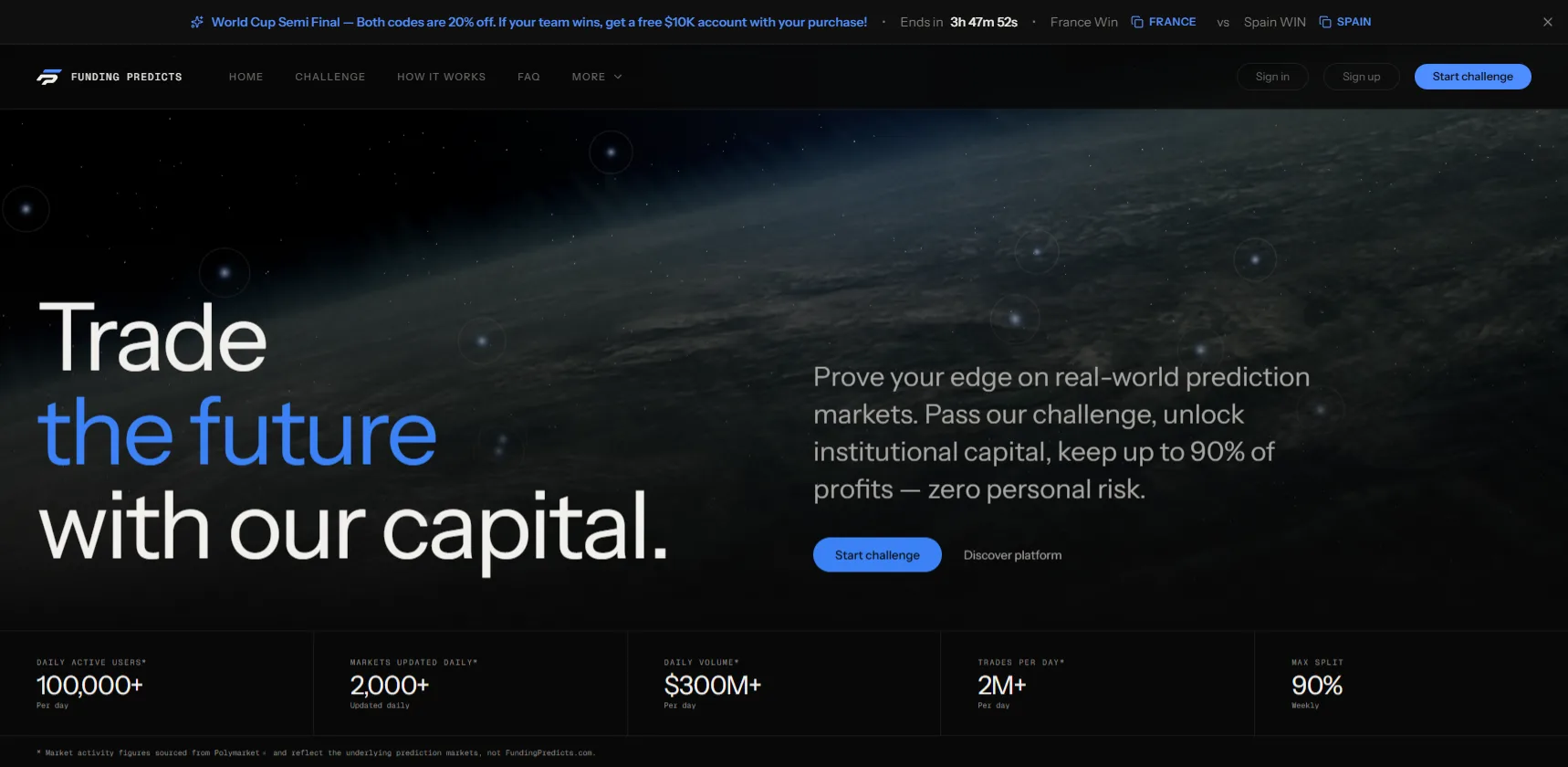
The rule that defines it: a daily loss limit on every account, which none of the others impose the same way.
It runs a single-phase evaluation on live Polymarket prices, and it is the only firm here where a bad day alone can end the attempt.
Every size carries three numbers: a profit target, a Trailing EOD maximum drawdown, and a daily loss limit at roughly 2% of the account.
The ladder is the most granular here. A free $1,000 account asks $60 of profit, allows $40 of drawdown, and caps a single day at $20.
From there: $10,000 for $85, $25,000 for $125, $50,000 for $209, $100,000 for $359 and $150,000 for $535. Targets sit at 6% throughout, so $9,000 on the largest size, with up to 45 days to reach it.
Once funded, the target disappears and the same risk rules carry over. Payouts run every seven days in crypto or fiat, funds stated to arrive within 72 hours, split reaching 90%. The backing is worth knowing.
The firm states that the MyFundedFutures team both invests in it and stands behind it, describing that business as having paid traders over $180M across 114,000+ payouts since 2023. In a category this young, sitting on established risk infrastructure is a structural advantage.
Two disclosures before buying. The homepage activity figures, including $300M daily volume, are footnoted as Polymarket’s rather than the firm’s own.
And the terms state that all accounts, evaluation and funded alike, run in a simulated, non-executing environment.
Pros: a free $1,000 account tests the whole rule set at no cost, the 6% target is the lowest here, and 45 days is generous for one phase.
Cons: the daily limit is tight in percentage terms, so one heavy session can end an otherwise sound evaluation.
2. For Traders
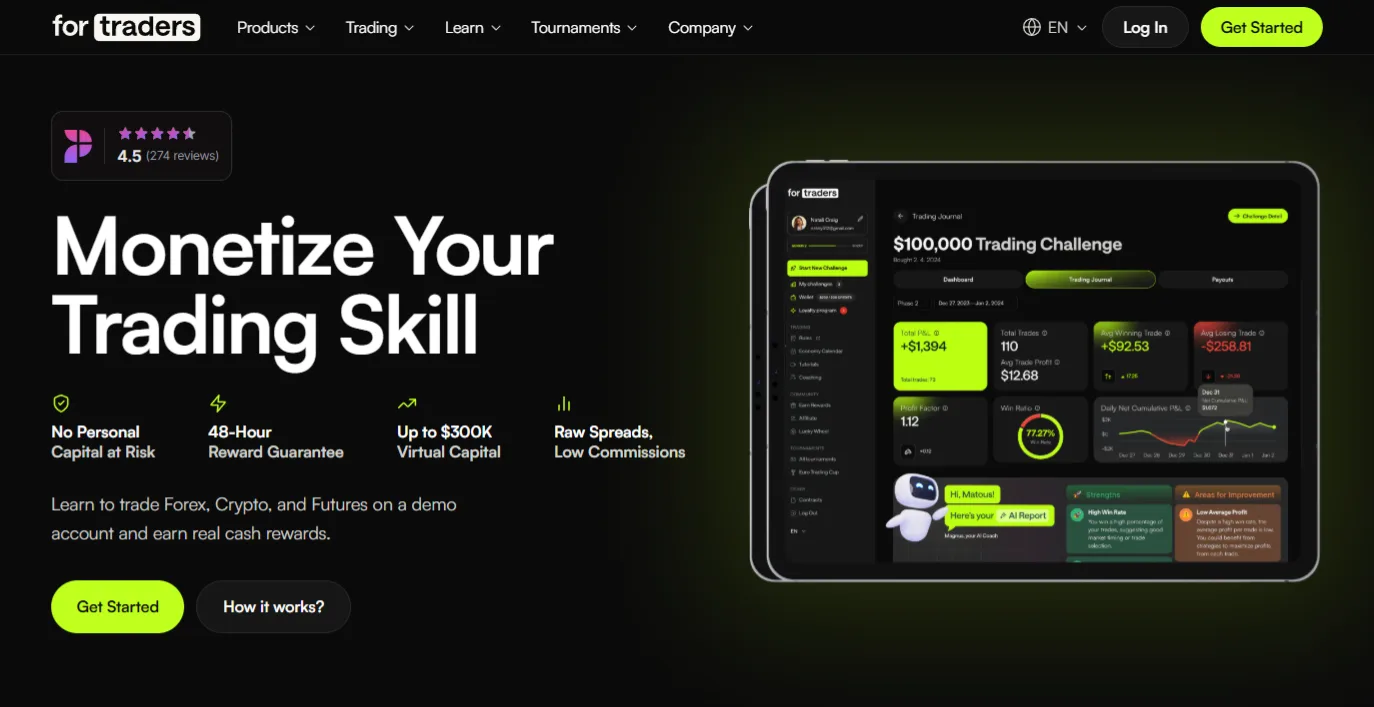
The rule that defines it: in the beta, real money withdrawals are not available. That sentence is the firm’s own, and it reframes the product.
For Traders calls itself the first company bringing prediction markets to prop traders, and runs it as a free-entry competition rather than a funded prediction account.
The mechanics: a $100,000 instant competition account with no evaluation, a 10% maximum total loss, 5% maximum risk per event and three open positions at a time, over three weeks.
The top ten win. Round three has ended, after a round two that handed out $585,000 worth of trading challenges across nineteen finishers.
What you win is the interesting part: a ForTraders.com challenge matching your tier, traded on crypto, forex or futures with payouts up to 90%. The prediction market side is the qualifier; the funded account at the end is a conventional one.
The wider firm is the most established here: founded 2023, over $10M paid out, 150,000 customers across 130 countries, virtual capital to $300,000, 48-hour payouts, and 2024 awards from Benzinga and Prop Firm Match.
The platform spans twelve market categories, politics and sports through to climate and health.
Pros: free entry, no evaluation, and a large firm behind it with a public payout record and named awards.
Cons: rounds open and close rather than running continuously, and the prediction account itself does not pay out, so it suits someone happy to convert a leaderboard finish into a standard challenge.
3. PropMarket

The rule that defines it: no daily drawdown at all, paired with a 20 to 80 cent price band. PropMarket is the most permissive on losses and the most restrictive on which contracts you may touch.
No daily loss limit applies at all; only total drawdown, set at 10% and measured as a Trailing Equity high water mark from your peak rather than your starting balance.
In exchange, three boundaries shape what you may trade. Contracts must sit between 20 and 80 cents, ruling out both long-shot lottery tickets and near-certainties.
Markets must resolve within 60 days. And no single market may produce more than 10% of your total profit, forcing real spread rather than one conviction bet.
No category is off limits, so any Polymarket section works inside those bounds. The evaluation is one step, 20% target, 30 days, from $59 one-time with no activation fee, across sizes from $5,000 to the $250,000 the homepage headlines.
Read the split carefully. The standard is 70/30, and the advertised 90/10 is a paid add-on costing 30% on top of the fee.
Two others exist: lifting the per-market cap from 10% to 20% costs 80% more, and doubling the window to 60 days costs 10% more. Funded payouts run weekly by direct deposit, with a 2% minimum profit per period and seven days between them.
Pros: dropping the daily loss limit is the most trader-friendly decision here, and the high water mark drawdown is explained plainly rather than buried.
Cons: the headline split and the longer window both cost extra, so the configuration most people picture lands well above $59.
4. PolyFundr
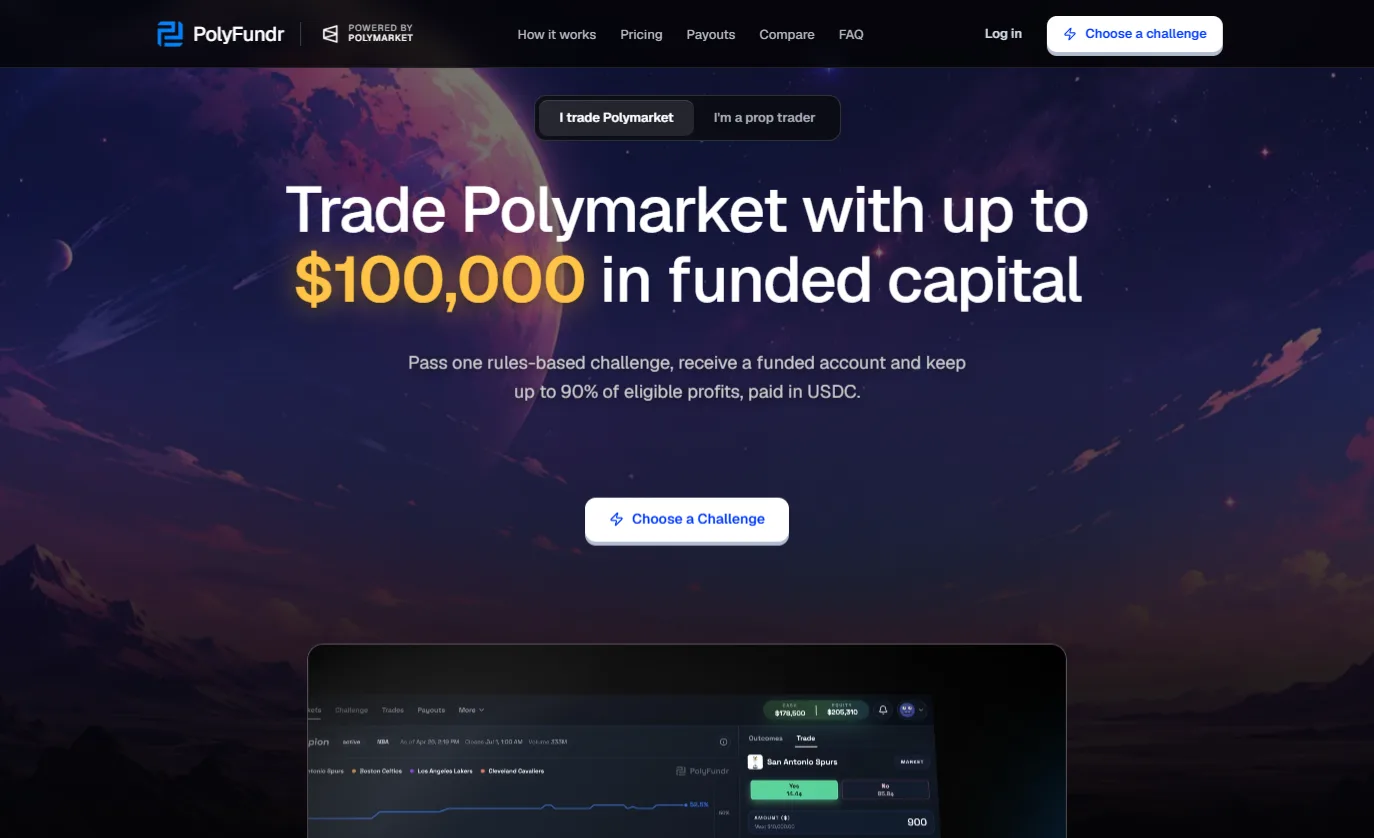
The rule that defines it: no time limit and no KYC, which removes both of the usual sources of pressure.
PolyFundr is the only firm here with no deadline. One trade every fourteen days keeps the account active, and beyond that you take as long as you need. Where your edge depends on specific events resolving, no clock is worth more than a point of split.
Tiers run Bronze $5,000, Silver $10,000, Gold $25,000 and Diamond $50,000, listed at $49, $125, $300 and $500, with a 50% discount running at the time of writing. Gold is marked most popular.
The Gold $25,000 rule set: a 30% profit target, so $7,500 realized; a 10% daily loss limit, breached if a single day’s PnL falls below -$2,500; a 20% total drawdown, failed above $5,000 cumulative; and a consistency cap holding any one day to 30% of total realized profit.
Payouts settle in USDC, requested from the dashboard once realized profit hits the target, with the split reaching 90%. Testimonials carry on-chain transaction hashes beside each payout figure, an unusually checkable touch.
The free demo deserves a mention: $1,000 of practice capital governed by the same core evaluation rules, requiring no card and lasting three days.
One figure to reconcile: the headline promises up to $100,000 of funded capital while the tier ladder and the calculator both stop at $50,000. Take the ladder as operative.
Pros: no deadline, no KYC, USDC settlement, a real free trial of the rules, and the clearest tier ladder of the five.
Cons: the 30% target is the highest here, and the 30% consistency cap means reaching it takes at least four solid days rather than one great one.
5. PolyFunded

Where things stand: at the time of writing the PolyFunded platform was not serving. Its domain returns a disabled-deployment response rather than the site, and no archived copy of its terms is available either.
So there is nothing current to quote. Rather than repeat figures that cannot be checked against the firm’s own pages today, its rules, pricing and payout terms are best confirmed directly with PolyFunded before any purchase.
If the platform returns, ask the same four questions that separate everyone above: is there a daily loss limit, does a time limit apply, what is the standard split before add-ons, and does any price band or resolution window restrict which contracts count.
In the meantime: the four above all publish live rule sets, and three let you test them at no cost, via Funding Predicts‘ free $1,000 account, PolyFundr’s three-day demo or a For Traders round.
Prediction Market Prop Firms Compared
The biggest differences come down to entry cost, profit target, loss limits, time pressure and payout structure, rather than account size alone.
| Prop Firm | Entry | Profit Target | Daily Loss Limit | Time Limit | Profit Split |
| Funding Predicts | Free–$535 | 6% | ~2% | 45 days | Up to 90% |
| For Traders | Free | Competition-based | 5% risk/event | 3 weeks | Up to 90% |
| PropMarket | From $59 | 20% | None | 30 days | 70% standard |
| PolyFundr | 49–500 | 30% | 10% | None | Up to 90% |
| PolyFunded | Unverified | Unverified | Unverified | Unverified | Unverified |
Choosing Between Them
Ask what would actually end your attempt.
If a single bad day is the risk, PropMarket is the only firm here with no daily loss limit, and Funding Predicts is where that limit bites hardest.
If time pressure is the risk, PolyFundr removes the deadline. PropMarket allows 30 days, or 60 for 10% more. Funding Predicts allows 45.
If the target is the risk, Funding Predicts asks 6% and PolyFundr asks 30%. That gap dwarfs any difference in fee and should weigh more heavily than it usually does.
To see the mechanics before paying: Funding Predicts’ free $1,000 account, PolyFundr’s demo, or a For Traders round when the next opens.
Frequently Asked Questions
Which Prediction Market Prop Firm Has the Lowest Profit Target?
Funding Predicts at 6% on every size, so $60 on the free $1,000 account and $9,000 on the $150,000. PropMarket asks 20%, PolyFundr 30%.
Can I Trade Prediction Markets with A Funded Account for Free?
Funding Predicts offers a free $1,000 funded account with a $60 target, $40 drawdown and $20 daily limit.
PolyFundr’s demo gives three days on those same evaluation rules, and For Traders‘ rounds cost nothing to enter.
Which Firm Has No Daily Loss Limit?
PropMarket. Its rule card states no daily loss limit applies, only total drawdown, measured as a 10% trailing equity high water mark from peak balance.
Is the 90% Profit Split Standard?
Not everywhere. Funding Predicts and PolyFundr both advertise up to 90% within normal terms.
PropMarket’s standard is 70/30, and 90/10 is a paid add-on costing 30% more on the fee.
Are There Restrictions on Which Markets I Can Trade?
At PropMarket, yes: contracts must sit between 20 and 80 cents, resolve within 60 days, and no single market may generate more than 10% of total profit, though every Polymarket category is permitted.
The others publish consistency rules rather than price bands.
How Do Payouts Work on Prediction Market Prop Accounts?
Funding Predicts pays every seven days in crypto or fiat, funds stated to arrive within 72 hours.
PolyFundr settles in USDC on request from the dashboard. PropMarket pays weekly by direct deposit, with a 2% minimum profit per period and seven days between payouts.