
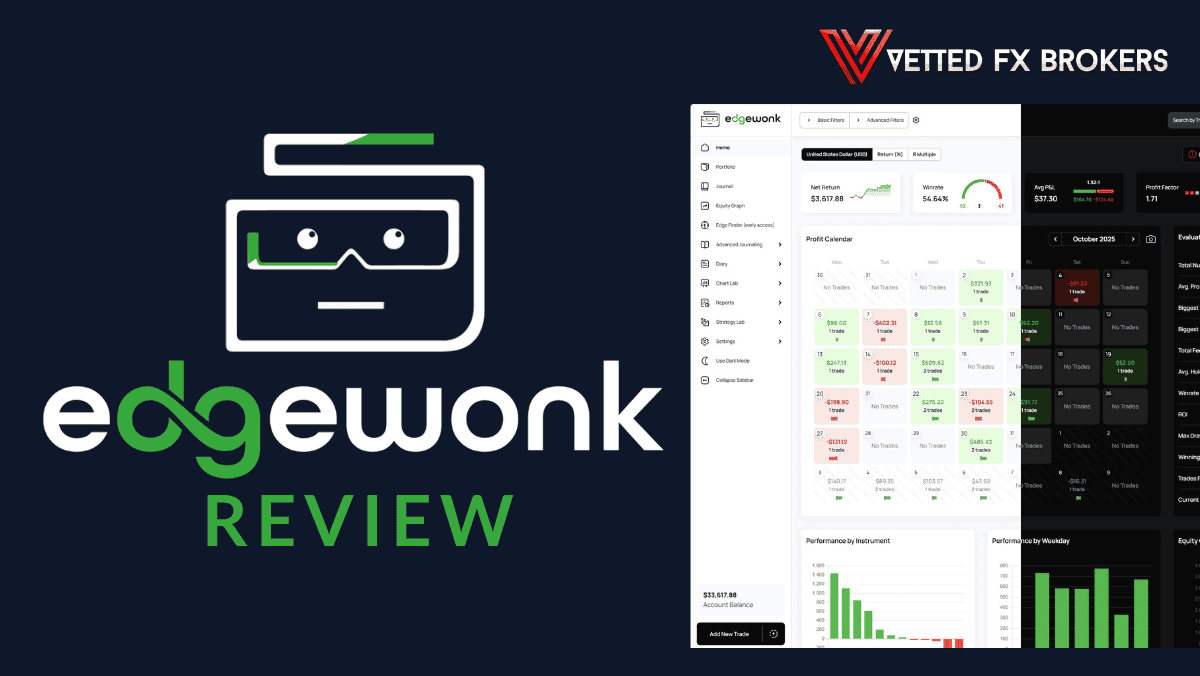

Many traders search for the perfect strategy, yet they overlook a simple truth: results improve only after careful analysis of past trades.
A trader who does not review decisions rarely understands why profit appears one week and losses appear the next.
Edgewonk addresses that problem through detailed performance analysis and structured trade journaling.
This review explains how Edgewonk works and how traders use its tools to uncover profitable patterns.
What Makes Edgewonk Different From Other Trade Journals

Most trade journals focus on record keeping.
Edgewonk goes further by studying the behavior behind each trade. The platform does not only track profit and loss. It also analyzes decision quality and strategy discipline.
The software focuses on three key areas:
- Performance analysis
- Strategy rule adherence
- Trader behavior
For example, a trader may record a profitable trade that broke several rules. A simple journal would treat that trade as a success.
Edgewonk identifies the rule violation and flags the decision as risky behavior. Over time, this analysis helps traders recognize habits that damage long-term performance.
The goal of the platform is simple: help traders identify the conditions that produce consistent results.
The Edge Finder: Discovering Profitable Patterns

One of the most distinctive tools inside Edgewonk is called the Edge Finder. This tool scans trade history and highlights patterns in performance.
Instead of manually reviewing hundreds of trades, the system identifies relationships between trade conditions and profit outcomes.
For example, the Edge Finder may reveal insights such as:
- Highest win rate during morning market sessions
- Strongest performance with a specific trading setup
- Weakest results on certain currency pairs
Imagine a trader who reviews six months of forex trades.
The Edge Finder may show that trades placed between 9:00 and 11:00 AM generate most of the profit. Trades executed later in the day may show lower success rates.
This type of analysis allows the trader to focus only on the most profitable conditions. Many traders discover their best strategies through this pattern analysis.
Trade Management Optimizer: Improving Exit Decisions

Entry timing often receives most of the attention in trading discussions.
However, exit decisions frequently determine the final result of a trade. Edgewonk addresses this issue through the Trade Management Optimizer.
This tool studies how traders manage positions after entry. It analyzes several elements of each trade:
- Stop-loss placement
- Take-profit targets
- Exit timing
- Price movement after exit
A trader may close a position at a small profit because of fear of reversal. The optimizer compares that exit with the price movement that occurred afterward.
For instance, a trader may exit a trade with a $150 profit, yet the optimizer may reveal that the market later moved far enough to produce a $450 profit.
This analysis helps traders understand how early exits affect long-term results. Some traders discover that their strategy performs well, but poor exit decisions reduce total profit.
Strategy Checklists and Rule Discipline
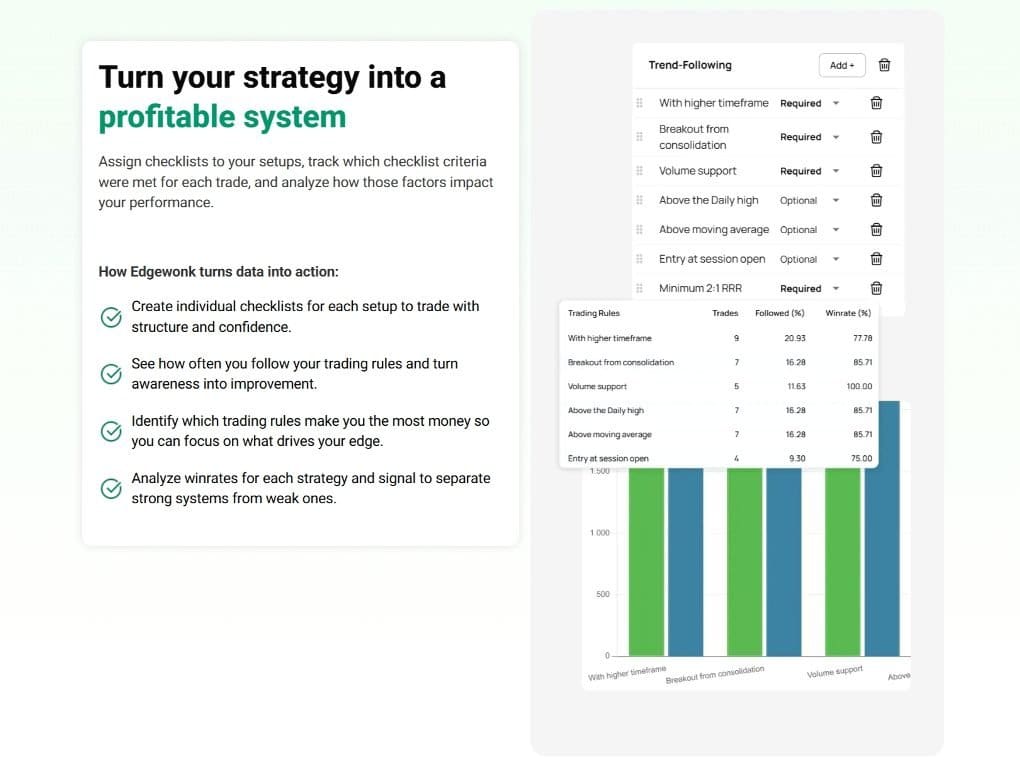
Edgewonk also includes strategy checklists that allow traders to evaluate each trade against specific rules. These checklists create a structured approach to strategy execution.
A trader can define rules such as:
- Market trend aligns with trade direction
- Support or resistance level confirms entry
- Minimum risk-reward ratio of 1:2
Before or after a trade, the trader completes the checklist to confirm whether the setup met the criteria.
Over time, Edgewonk tracks how often the trader follows these rules. If a trader ignores the checklist frequently, the platform highlights those rule violations.
This system encourages discipline. Traders often discover that losses occur when they ignore their own strategy rules.
Psychology Tracking and the Tiltmeter

Trading psychology plays a major role in performance.
Fear, impatience, and frustration often lead to poor decisions. Edgewonk attempts to measure this behavior through a feature known as the Tiltmeter.
The Tiltmeter monitors trading activity and identifies emotional patterns.
Examples include:
- Rapid trade entries after a losing position
- Sudden increases in trade frequency
- Rule violations during losing streaks
Suppose a trader experiences three losses in a row. The Tiltmeter may show that the trader immediately placed several additional trades in an attempt to recover losses.
This pattern often indicates emotional trading rather than strategic decision-making.
By tracking these situations, traders gain awareness of psychological habits that affect performance.
Trade Imports and Platform Integration

Edgewonk allows traders to import trade data directly from broker platforms. This process converts broker statements into journal entries within seconds.
The most common import methods include:
- CSV file uploads
- Broker statement imports
- MetaTrader synchronization
Many retail traders use platforms such as:
- MetaTrader 4
- MetaTrader 5
- NinjaTrader
- Interactive Brokers
Trade data exported from these platforms can be uploaded to Edgewonk for analysis.
For example, a trader who completes 500 trades in several months can upload the entire trade history and allow the system to organize the records automatically.
This approach removes the need for manual trade logging.
Performance Reports That Reveal Trading Behavior

Edgewonk produces detailed reports that summarize trading activity. These reports allow traders to evaluate performance from several angles.
The platform can generate insights such as:
- Most profitable trading setups
- Strongest trading days of the week
- Average trade duration
- Largest drawdown periods
- Profit and loss streaks
For example, a trader may discover that Tuesday trades consistently produce losses while Thursday trades show strong results.
That type of pattern may lead the trader to reduce activity on weaker days.
The platform also displays an equity curve showing the account balance over time. This curve allows traders to measure consistency and evaluate periods of strong or weak performance.
Edgewonk Pricing

Edgewonk uses a simple pricing structure that provides full access to the platform.
The main subscription options include:
Annual Plan
- Approximately $169 per year
- Full access to journaling tools
- Unlimited trade imports
- Full analytics features
Two-Year Plan
- Approximately $297 for two years
- Identical feature set
- Lower effective annual cost
The platform also includes a 14-day money-back guarantee, which allows traders to test the software before committing long-term.
Frequently Asked Questions
Can Edgewonk Track Trades from Multiple Trading Accounts?
Yes. Edgewonk supports multiple trading accounts within the same journal.
A trader who operates several broker accounts can import trades from each account and review combined performance statistics or analyze each account separately.
Does Edgewonk Allow Traders to Attach Charts or Notes to Each Trade?
Yes. Traders can add detailed notes, screenshots, and comments to every trade entry.
Many traders attach chart images that show entry points, support levels, or market structure so they can review the exact context of the trade later.
Can Edgewonk Analyze Losing Streaks and Drawdowns?
Yes. The platform includes reports that highlight losing streaks and drawdown periods.
These reports help traders understand when performance begins to decline and which trades or market conditions caused the downturn.
Is Edgewonk Suitable for Traders Who Follow Strict Trading Plans?
Yes. Edgewonk works well for traders who rely on structured trading plans.
The checklist system allows traders to compare each trade against predefined rules and quickly identify situations where the strategy rules were ignored.
Conclusion
Edgewonk focuses on one core idea: a trader must understand past decisions before consistent improvement becomes possible.
The platform records trades, analyzes performance patterns, and reveals behavioral habits that affect results. Tools such as the Edge Finder, trade management optimizer, and strategy checklists help traders identify profitable conditions while reducing mistakes.
Psychological tracking features add another layer of insight by highlighting emotional behavior during trading sessions.
For traders who want structured analysis rather than guesswork, Edgewonk provides a system that transforms trade history into valuable performance data.