


Brokers that lead with zero commission are usually making the money somewhere else.
That is not a criticism, it is just where the reading has to start, and Evest makes the reading unusually easy because it publishes the whole fee schedule and a per-instrument spread table rather than a single “from” figure.
So this review follows the money: what the tiers cost to enter, what you pay per trade, what you pay when nothing is happening, and who is actually holding the licence.
Key Takeaways: four deposit-banded tiers from $250, free deposits and free account opening, EURUSD from 0.9 pips falling to 0.1 at the top tier, a $5 withdrawal fee, and an inactivity charge that starts at $75.
The Four Tiers
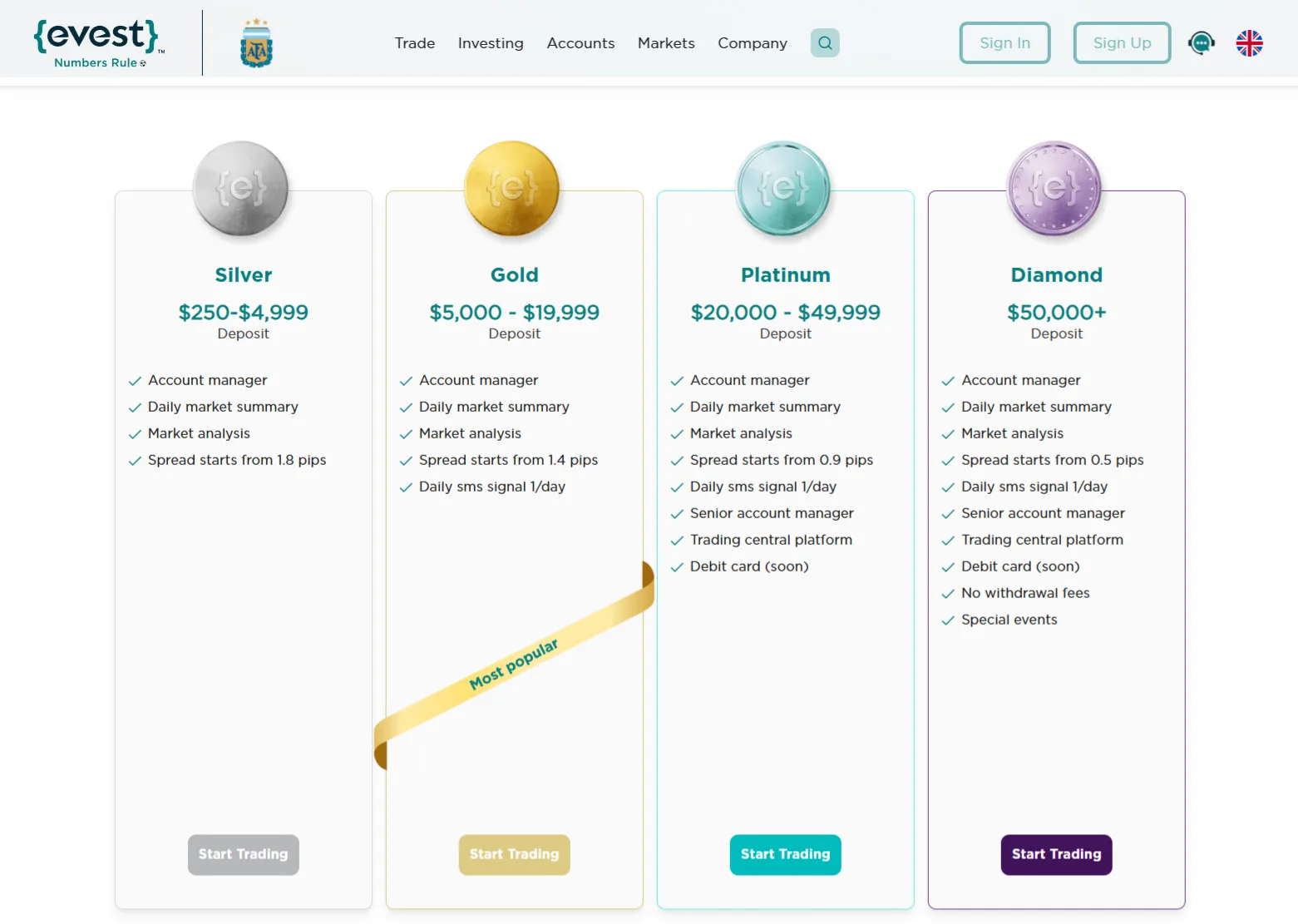
Account level is decided by what you deposit, and the practical effect is on your spread rather than on which markets you can reach.
| Tier | Deposit | Headline spread | What is added |
| Silver | $250 to $4,999 | from 1.8 pips | Account manager, daily market summary, market analysis |
| Gold | $5,000 to $19,999 | from 1.4 pips | Daily SMS signal |
| Platinum | $20,000 to $49,999 | from 0.9 pips | Senior account manager, Trading Central, debit card coming |
| Diamond | $50,000+ | from 0.5 pips | No withdrawal fees, special events |
Entry sits at $250, which is a reasonable floor. The useful thing about this structure is that nothing meaningful is withheld at the bottom: a Silver client still gets an account manager, daily market commentary and analysis.
What climbing buys is a tighter spread and, at Diamond, the removal of withdrawal charges.
What You Actually Pay Per Trade
The headline tier figures are “starting from” numbers across everything Evest offers, so the per-instrument table is where the real answer sits, and the two do not say quite the same thing.
On the majors, spreads are considerably better than the tier headlines suggest.
EURUSD runs 0.9 pips at Silver, 0.7 at Gold, 0.5 at Platinum and 0.1 at Diamond. GBPUSD goes 2.3, 1.7, 1.2 and 0.7. USDCHF and AUDUSD both start at 1.5 and finish at 0.5 and 0.6 respectively. EURGBP runs 1.8 down to 0.7.
Move away from the majors and the numbers change character entirely. EURTRY is quoted at 150 pips even at Silver, USDTRY at 172, and EURNOK at 107.
Those are not unusual for the pairs involved, but they are worth seeing before you assume a tier’s headline figure travels across the whole book.
For stocks the pitch is cleaner: no ticketing fees, no rollover fees, no management fees and no additional or hidden broker fees, alongside free account opening.
CFD terms sit at up to 400 leverage with a stop out at 20% margin, and positions can be opened from 10 points.
The Fees That Are Not Spreads
This is the section most brokers bury, and the one worth reading twice.
Deposits are free. Withdrawals cost $5 with a $25 minimum, and Diamond removes the charge entirely. Currency conversion runs at 2%, which matters if you fund in a currency other than your account’s.
Two charges need attention before you open anything. Withdraw before you have opened and closed any positions and a $25 processing fee applies.
And inactivity is charged at $75 after the end of your second month, dropping to $50 from the end of the third month onward, with open positions closed automatically to cover it if required.
That inactivity policy is the single most important line in the fee schedule for a casual trader. An account funded and then left alone starts costing money in month three, and it can close your positions to collect.
Anyone planning to trade occasionally rather than regularly should size their deposit with that in mind.
Platforms and Tools
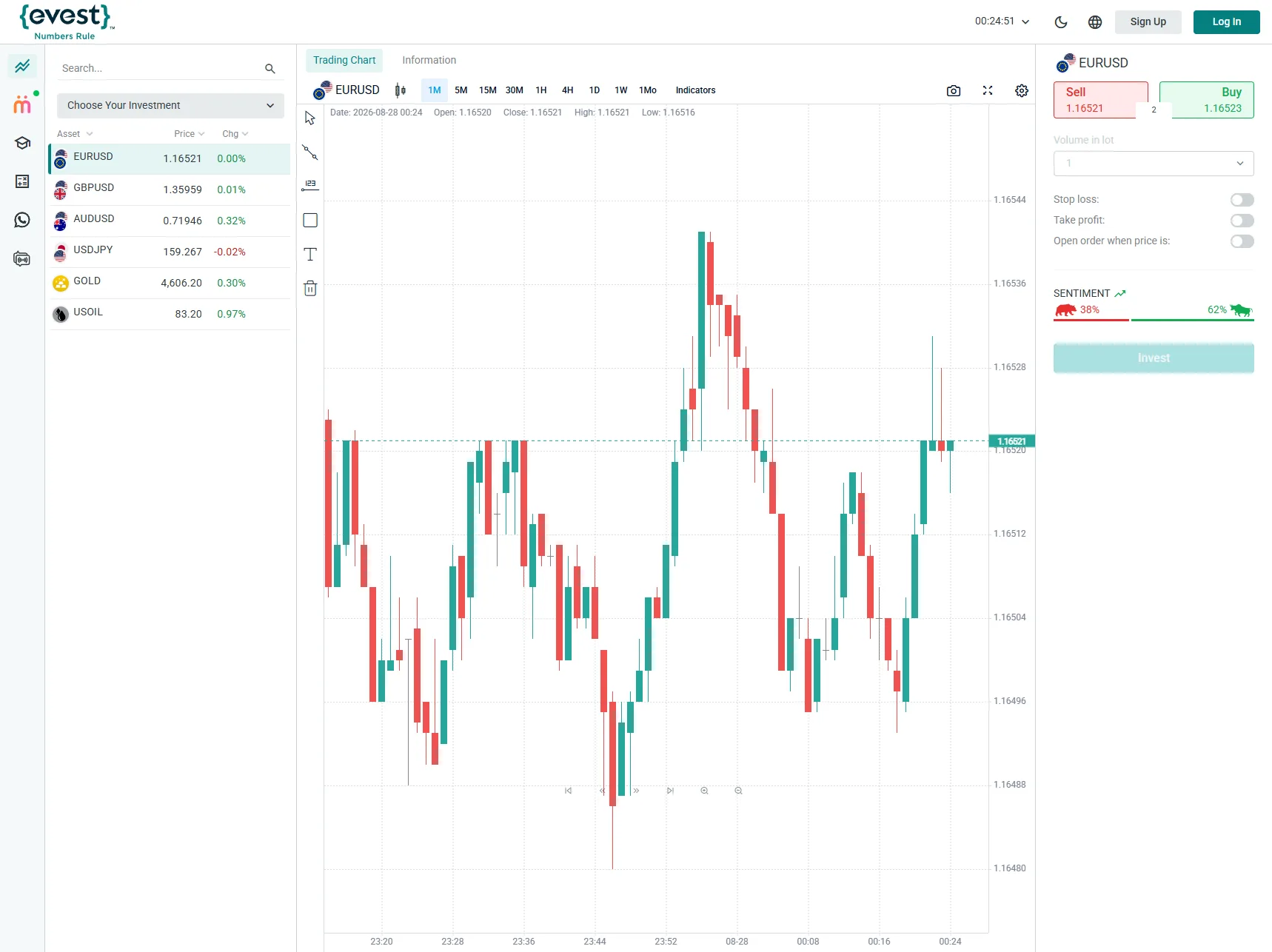
Trading runs through a web platform and mobile apps on both iOS and Android, with no desktop terminal in the line-up.
The research layer is more substantial than the platform list suggests. Trading Central and TipRanks both feature, alongside live webinars, a trading academy, calculators and copy trading.
Trading Central is gated to Platinum and above, so the deposit tier decides your research access as well as your spread.
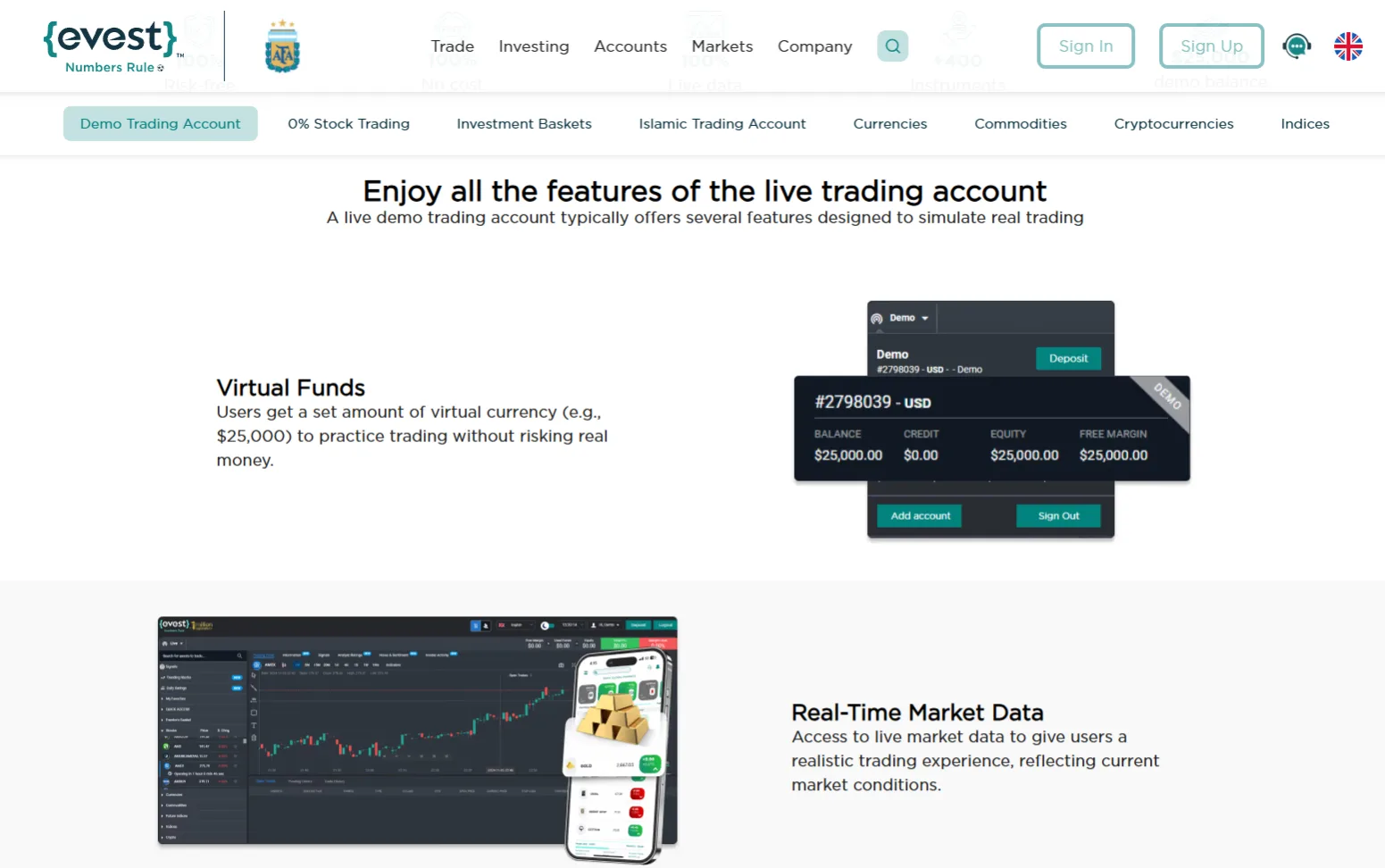
Investment Baskets and an Islamic swap-free account round out the account options, with a demo account available for anyone wanting to see the platform before funding.
Who Holds the Licence
Evest is a brand rather than a single regulated entity, and the structure is worth understanding.
The brand is owned by Atriafinancial Holdings Ltd, incorporated in the United Kingdom under registration 12745548, at 11 Blackheath Village, London. That holding company sits above three regulated operating entities.
Atriafinancial Ltd is authorised by the Vanuatu Financial Services Commission under the Financial Dealers Licensing Act with registration 17910.
Atriafinancial SA (Pty) Ltd is authorised by South Africa’s Financial Sector Conduct Authority as a financial service provider under licence 36060.
Atriafinancial (Comoros) Ltd is authorised by the Mwali International Services Authority under licence T2023414.
Payments run through separate agents: Atriafinancial Business Services Ltd in Cyprus under registration HE 419548 handles Paysafe transactions, Atriafinancial Capital Limited in the UK acts as a paying agent, and clients in the GCC region are served by Atria Financial Limited W.L.L.
The practical reading is that your counterparty depends on where you are, so check which entity your account is opened under, since the protections attached to a Vanuatu licence differ from those attached to an FSCA one.
Evest also carries the standard disclosure that CFD trading is highly speculative and carries a high level of risk.
Is It For You
Worth a look if you trade majors actively and can fund at Platinum or above. A 0.5 pip EURUSD spread with Trading Central included is a competitive package, and the absence of ticketing, rollover and management fees on stocks is genuinely clean.
Less suitable if you intend to deposit and trade sporadically. The inactivity charge arriving in month three is the wrong fee structure for an occasional trader, and the 2% conversion cost adds up if your funding currency does not match your account.
What Evest does better than most is disclosure. A full fee table, a per-instrument spread grid across four tiers, and a complete list of licensing entities are all published rather than summarised, which lets you price the account before opening it.
Just make sure the figure you price it on is the one from the instrument table rather than the tier headline.
Frequently Asked Questions
What Is the Minimum Deposit at Evest?
$250, which opens a Silver account including an account manager, daily market summary and market analysis.
How Much Are Evest’s Spreads?
They vary by tier and instrument. EURUSD starts at 0.9 pips on Silver and tightens to 0.1 on Diamond, while GBPUSD runs from 2.3 down to 0.7. Exotic pairs are far wider, with EURTRY quoted at 150 pips at Silver.
Does Evest Charge Withdrawal Fees?
$5 per withdrawal with a $25 minimum, removed entirely on Diamond accounts. A separate $25 processing fee applies if you withdraw before opening and closing any positions.
Is There an Inactivity Fee?
Yes. $75 after the end of the second month, reducing to $50 from the end of the third month onward, and open positions may be closed automatically to cover it.
Who Regulates Evest?
The brand belongs to UK-registered Atriafinancial Holdings Ltd, which sits above three licensed entities: one authorised by the Vanuatu Financial Services Commission, one by South Africa’s FSCA under licence 36060, and one by the Mwali International Services Authority in Comoros.
What Can I Trade?
CFDs on currencies, indices, commodities and crypto, plus stocks with zero commission and no ticketing, rollover or management fees.
Investment Baskets and an Islamic swap-free account are also available.