


FTMO US sells two versions of the same evaluation. One is ten dollars cheaper to start and considerably more expensive to finish.
The headline difference looks like phase count. The difference that costs you money is what happens to your fee after you pass.
This review works through both products on the rules that decide your outcome. It then follows the rewards out to your bank.
Pro Tip: The 2-Step fee is reimbursed with your first reward and the 1-Step fee is not. Price the 1-Step as a permanent cost you pay for speed and a flat 90% split. Its 3% daily loss limit is also tighter than the 5% on the 2-Step.
The Fee Refund Nobody Mentions

Both products charge one fee with no recurring costs. What happens to that fee afterwards is where they separate.
The 2-Step Pays You Back
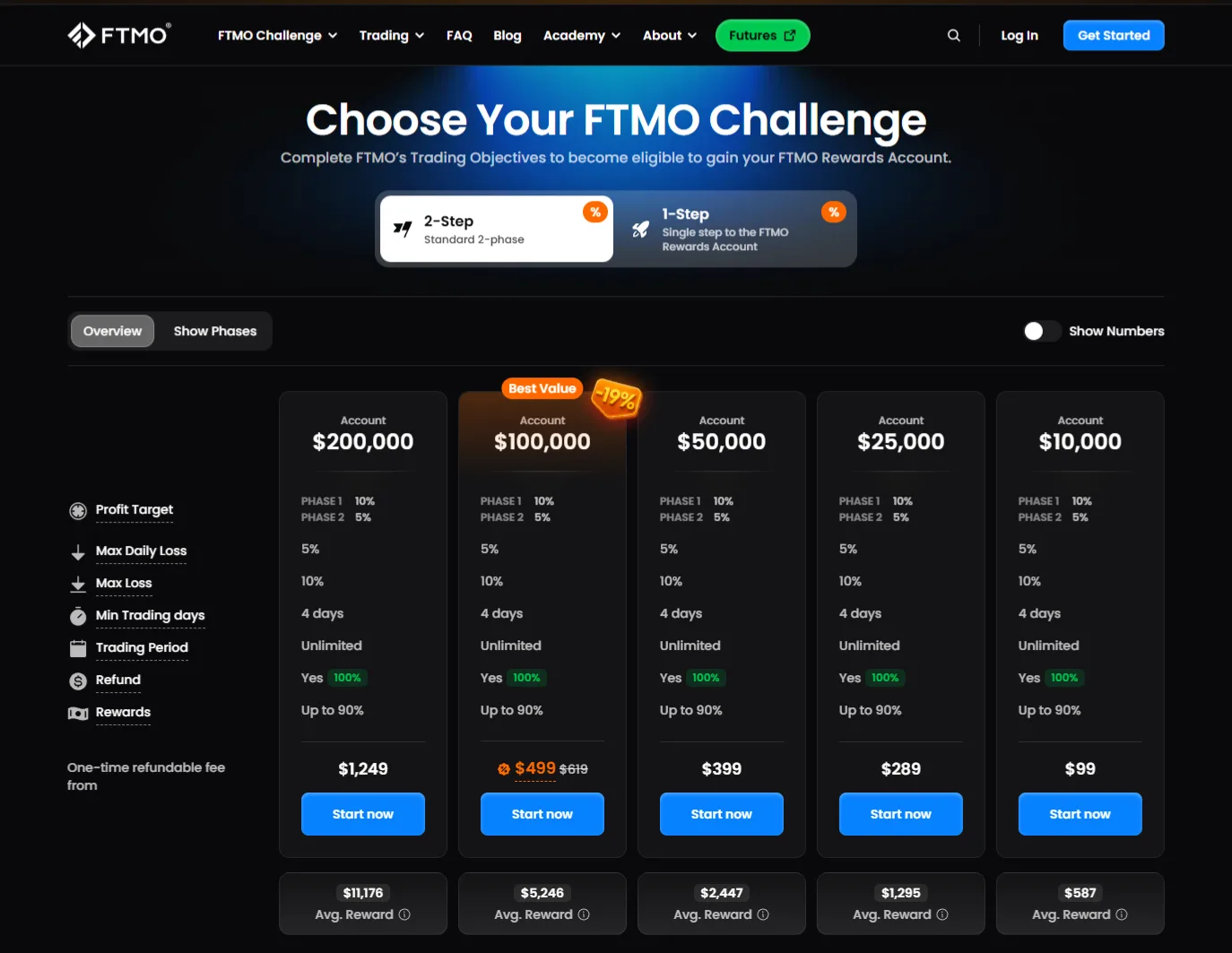
The 2-Step Challenge starts from $99 and runs two phases. Clear both and the fee is reimbursed with your first reward withdrawal.
That makes the real cost zero for anyone who reaches a payout. You are fronting the money rather than spending it.
The 1-Step Does Not
The 1-Step starts from $89 and runs a single phase. The entry fee is non-refundable and is never reimbursed with your reward.
So the cheaper product is only cheaper until you pass. After that the 2-Step is the one that hands your money back.
Static Versus Trailing Max Loss
Both products cap total loss at 10% of your initial simulated capital. They calculate that cap in opposite ways.
Static on the 2-Step
The 2-Step maximum loss is a static limit. It is your initial capital minus 10% of that capital, and it does not move.
Grow the account and your floor stays where it started. Every dollar of profit becomes genuine breathing room.
End of Day Trailing on the 1-Step
The 1-Step limit trails. It recalculates daily from the highest balance recorded at midnight Central European time on any previous day.
The limit can only rise and never fall. Profit you bank today permanently lifts the floor you have to stay above tomorrow.
What Happens After a Withdrawal
There is a reset built into the 1-Step. When a reward is withdrawn and a new Rewards Account is issued, the maximum loss limit fully resets.
Your first-day limit goes back to 90% of the initial simulated capital. The trailing clock starts again from there.
The Best Day Rule
The 1-Step carries a consistency mechanism that the 2-Step does not. It is worth understanding before you plan a strategy around one big session.
How the 50% Test Works
Your best day must not represent more than half of your positive days’ profit. A single session that carries most of your gains puts you outside the rule.
The maths pushes you toward spread results. In practice the firm describes three trading days as the realistic minimum on the 1-Step.
Why It Is Not a Breach
Exceeding the Best Day limit does not fail your account. The firm is explicit that this is not treated as a rule breach.
Instead you keep trading until the ratio corrects itself. Additional profit on other days brings your best day back under 50%.
One warning sits alongside it. Spreading profit artificially, by hedging or holding opposing positions on correlated instruments, is a forbidden practice.
Three Routes to a 90% Split
The 2-Step advertises up to 90%, and the base rate is 80%. Here is how each route to the higher number actually works.
| Route | Split | What It Takes |
| 1-Step Rewards Account | 90% | Applies from day one, no qualification needed |
| 2-Step base rate | 80% | The standard rate on a Rewards Account |
| Scaling Plan | 90% | Four months trading, 10% net profit, two processed rewards, positive balance |
| Premium Prime | 90% | Active account, no failure in four months, four rewards of 4% or more |
The Scaling Plan also grows your account by 25% every four months. The ceiling is $2,000,000 across all your Rewards Accounts. The Premium Program is free to join, and Prime adds a dedicated support agent and a 10% discount on challenges.
Premium benefits apply only in a limited scope to traders who qualified through the 1-Step.
How Rewards Reach Your Bank

Payouts are requested on demand rather than on a fixed date. Two conditions gate the first one.
The 14 Day Hold
You can request a reward after a minimum of 14 days from your first day of trading. The account has to be in positive profit with no open positions or pending orders.
Requests go into a review queue. You get instructions by email within one to two business days. The transfer runs one to two business days after the invoice is confirmed.
The $20 Floor
There is no minimum profit target to withdraw, only enough to cover the transfer fee. That works out at $20 of closed profit.
Rewards are paid by Revolut bank wire. You can also leave the money in the account to compound. Converting it to FTMO Points is an option too, and those points expire.
The Practices That End an Account
The forbidden practices list covers both the evaluation and the Rewards Account. Exploiting price display errors or a slow data feed is the first item on it.
Gap trading is named specifically. That means opening positions around scheduled major news. It also covers the two hours before a market closes for at least two hours.
Expert advisors are allowed as a strategy, with a technical ceiling. Accounts are limited to 200 pending orders and roughly 2,000 order actions per day before anti-flood protection triggers.
News and weekend restrictions are narrower than most traders expect. They apply only to Standard accounts, and only once you are on a Rewards Account, while Swing accounts carry neither.
Who Should Pick Which

- Confident of passing: the 2-Step, because the fee comes back with your first reward
- Want speed over refunds: the 1-Step, with one phase and no minimum trading days
- Trade through news and weekends: a Swing account, which carries no restrictions on either
- Plan to scale: the 2-Step, since the Scaling Plan route to 90% is written for it
- Uneven daily results: the 2-Step, which has no Best Day Rule to satisfy
Frequently Asked Questions
Does FTMO US Refund The Challenge Fee?
Yes on the 2-Step, where the fee is reimbursed with your first reward withdrawal. The 1-Step fee is non-refundable.
What Is The Best Day Rule?
Your best day must not exceed 50% of your positive days’ profit. It applies to the 1-Step only, and going over it is not treated as a breach.
How Long Before You Can Withdraw?
A minimum of 14 days from your first day of trading. The account must be in positive profit with no open positions or pending orders.
What Is The Minimum Payout?
Twenty dollars of closed profit, which exists to cover the bank wire fee. Rewards are paid by Revolut bank wire.
How Do You Reach A 90% Split On The 2-Step?
Through the Scaling Plan or Premium Prime status. Both require several months of trading and multiple processed rewards before the higher rate applies.
Final Thoughts
The 1-Step is the better product for getting to a Rewards Account quickly at a flat 90% split. It charges for that with a tighter 3% daily loss limit and a trailing maximum loss. The fee is also one you never see again.
The 2-Step asks for more patience and gives more back. A static loss floor, no Best Day Rule and a refunded fee all favour the patient trader. Decide on that expectation, not the ten dollar gap at checkout.