

Signal copying has a boring failure mode. Not a bad call from the provider, but a message that arrives at two in the morning and never reaches your account because a virtual machine somewhere fell over.
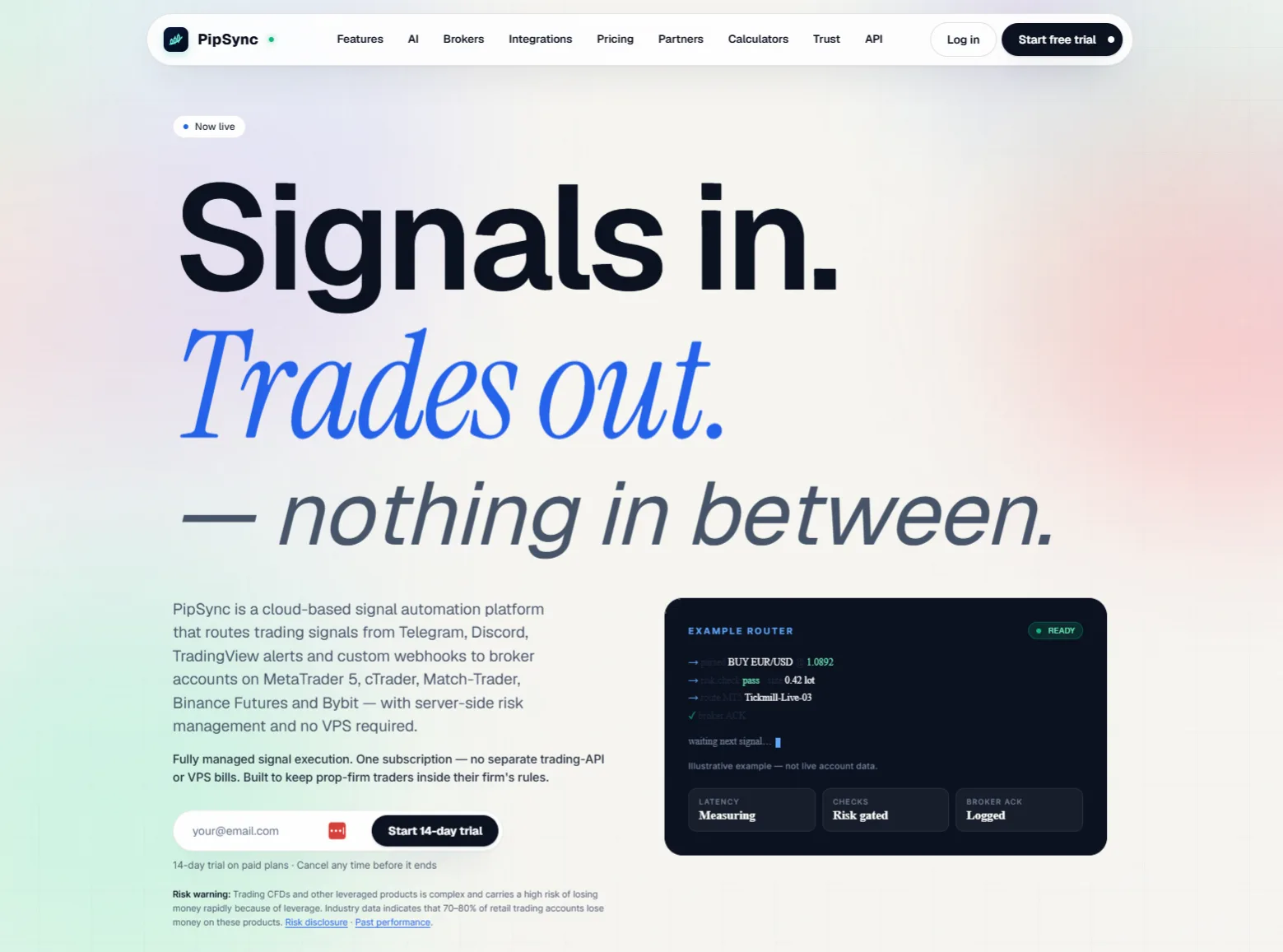
PipSync.io is built around that specific problem. It sits in the cloud between wherever your signals arrive and wherever your money sits, parses what comes in, checks it against your risk rules, and sends the order.
Nothing runs on your laptop. Nothing runs on a rented server you have to patch.
Key Takeaways: A server-side router that takes signals from Telegram, Discord, TradingView alerts and webhooks, applies your position sizing and drawdown limits before anything is sent, then executes on MetaTrader 5, cTrader, Match-Trader, Binance or Bybit. Execution plans start at $24 a month after a fourteen day trial.
What It Actually Does
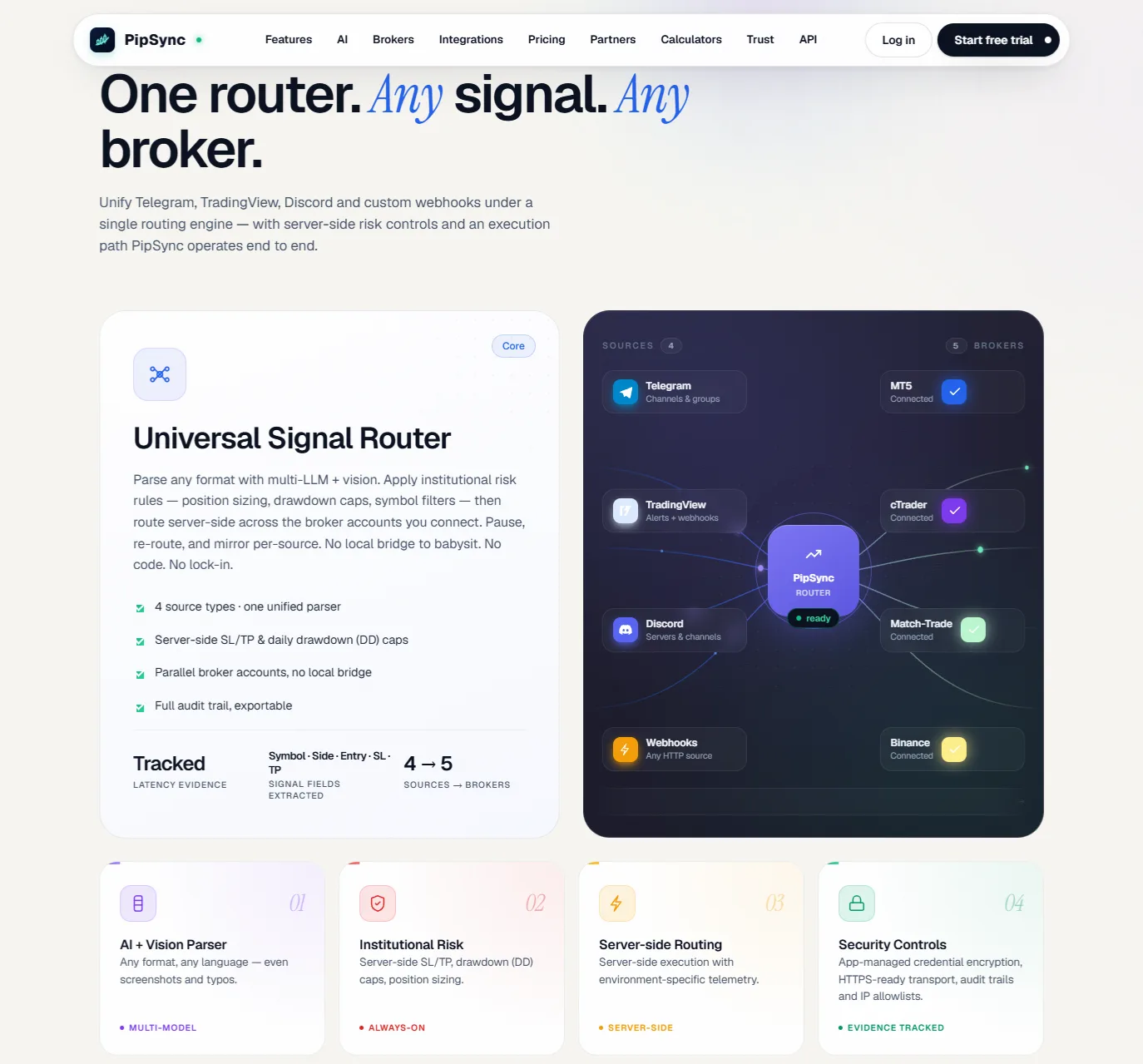
Four signal sources in, five broker types out, one routing engine in the middle.
The sources are Telegram channels and groups, Discord servers, TradingView alerts and any HTTP webhook you want to point at it. Connecting one is described as a sixty second job through OAuth or an invite link.
The brokers are MetaTrader 5, Match-Trader, Binance, Bybit and cTrader, the last connecting through cTrader ID on demo or live accounts. MetaTrader 4, OANDA, IG and Interactive Brokers are listed as roadmap rather than shipped, and Interactive Brokers carries a stated target of the third quarter of 2026.
Because the whole thing runs server side, it keeps working with your machine closed. That is the practical argument for this category of tool and PipSync.io makes it without hedging.
The Parser Is the Interesting Part
Most copiers want signals in a tidy format. Real trading groups do not send tidy formats.
The parser here is described as multi-model with vision, which means it reads structured messages, loose free text, screenshots and chart images. Where a signal leaves out a stop or a target, it infers the missing field from context, and where confidence is low it flags the signal for review rather than firing it.
That review queue is the detail I would look for in any tool like this. A parser that guesses silently is worse than one that asks.
Language is not a barrier either, which matters if the channel you follow posts in something other than English.
Risk Rules That Run Before the Order
This is where the product separates itself from a chat scraper.
Position sizing, daily drawdown caps, maximum open trades, symbol filters and server-side stops and targets are all applied before an order leaves for the broker. Not after the fill, not by an expert advisor sitting on your own machine, but in the path between the signal arriving and the order being sent.
You can pause a source, a single symbol, or everything, and the change takes effect server side rather than waiting for a local bridge to notice.
Every parsed signal and every order lands in an audit trail you can query and export. If you have ever tried to reconstruct why a trade fired six weeks after the fact, you will know what that is worth.
The dashboard puts live equity, open positions, per-signal profit and loss, the feed from each source and your current risk exposure in one view, with drawdown alerts on top.
What the Plans Cost
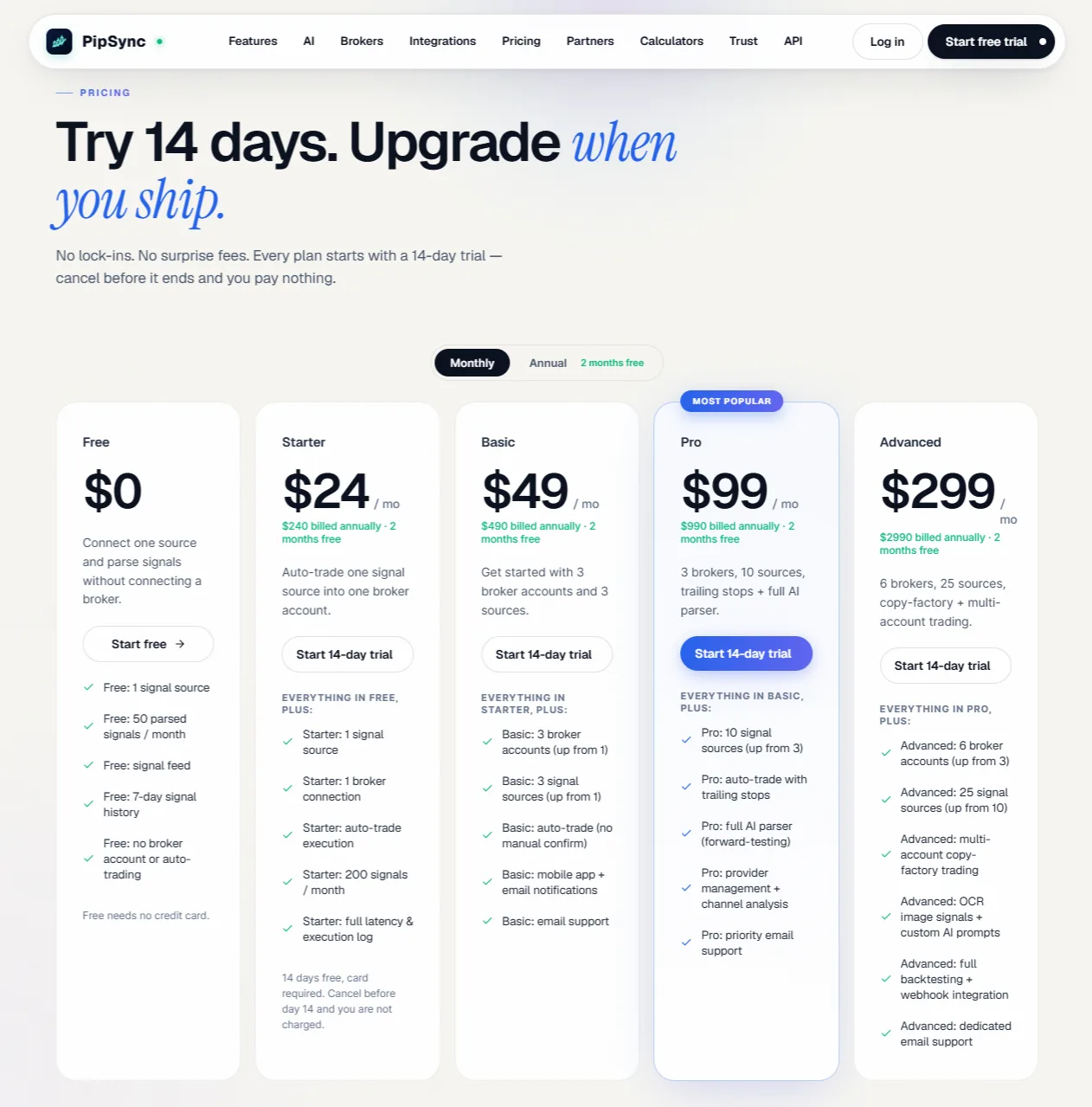
Five tiers, published openly, priced by seat rather than by signal. There are no execution fees and the company states it takes no commission from your broker, so it earns when you subscribe rather than when you trade.
The free plan parses but does not trade. One source, fifty parsed signals a month, a seven day history and no broker connection, which makes it a way to watch the parser work rather than a way to run a strategy.
Execution starts on Starter at $24 a month: one source, one broker, auto-trade and two hundred signals a month, with the full latency and execution log included. Basic at $49 lifts you to three brokers and three sources and adds the mobile app and email alerts.
Pro at $99 is where most active users will land. Ten sources, trailing stops, the full parser and channel analysis for judging which provider is actually worth following.
Advanced at $299 adds six broker accounts, twenty five sources, multi-account copy trading, image signal recognition, custom parser prompts, backtesting and webhooks. Enterprise starts at $1,999 with an SLA, dedicated infrastructure and a white-label option.
Annual billing takes two months off any tier. The fourteen day trial covers every paid plan, needs a card, and costs nothing if you cancel before day fourteen. In the eurozone the same figure is billed in euros with no conversion surcharge, so $24 becomes €24 rather than a moving exchange rate.
Talking to It Through Claude or ChatGPT
The newest piece is a connector that lets Claude or ChatGPT act as the front end for your account.
You add PipSync.io once as a connector, then ask in plain language: how is the gold position doing, close half, move the stop to break even. The assistant reads live quotes, open positions and pending orders, and every write is a two step confirm where it previews the action and you approve it.
The scope is trading only. The company states withdrawals are never in reach of the assistant, and the feature is currently early access rather than finished.
Who It Suits
Go for it if you follow more than one signal source and you are tired of the copier plus trading API plus rented server arrangement. Rolling those into one subscription is the pitch and the pricing supports it.
Go for it if risk discipline is the reason you want automation in the first place. Server-side caps that fire before an order goes out are a different thing from a rule you promised yourself you would follow.
Think harder about it if you trade on MetaTrader 4 or through a broker not yet on the list, since those are roadmap items. Also worth noting that the plan which actually executes trades starts after a trial that asks for a card, so the free tier will not tell you how it performs live.
Frequently Asked Questions
Do I Need a VPS to Run PipSync.io?
No. It runs server side in the cloud, with nothing installed on your own machine, and it keeps operating when your computer is off.
Which Brokers and Platforms Are Supported?
MetaTrader 5, Match-Trader, Binance, Bybit and cTrader, with cTrader connecting through OAuth on demo or live accounts. MetaTrader 4, OANDA, IG and Interactive Brokers are on the roadmap.
Is There a Free Plan?
There is, but it parses rather than trades. It covers one source, fifty parsed signals a month and a seven day history, with no broker connection. Auto-trading starts on the paid tiers.
What Happens to My Open Trades if The Service Goes Down?
Positions stay open at your broker, since PipSync.io never holds your funds. Pending signals expire with a notification if they cannot be processed, and availability is published on a public status page.
Can It Handle Signals Sent as Screenshots?
Yes. The parser is multi-model with vision, so it reads chart images and screenshots as well as text, and it flags anything it is unsure about for review.
Final Thoughts
What I like here is that the product is honest about being infrastructure rather than a money machine. It does not sell signals, it does not claim a win rate, and its own materials repeat that it cannot promise results.
What you are buying is the reliable middle: a parser that copes with messy messages, risk rules that apply before execution, an audit trail that survives scrutiny, and no server of your own to keep alive.
Start on the free tier to watch the parser handle your actual channels, then take the trial on Starter or Pro once you know the messages come through clean.