

High-frequency trading is the least standardised term in prop trading. Ask five firms what it means and you get five answers, and only one of them comes with a number attached.
That matters because the answer to “do you allow HFT” is meaningless without the definition behind it. One firm here permits it outright, subject to fairness conditions. One publishes a stopwatch figure and treats anything faster as HFT.
Two never use the phrase in their rulebooks at all, which leaves a different set of boundaries to read instead.
Quick Answer: FunderPro permits HFT explicitly, with limits. FTUK draws the line at 30 seconds. Funded Trading Plus publishes no HFT prohibition but bars tick-scalping. Bulenox welcomes bots and bars mass rapid churn. FunderPro Futures prohibits it in the terms, unlike its CFD sibling.
Prop Firms That Allow High-Frequency Trading (HFT)
Below are five firms and the exact point at which each one says fast becomes too fast.
1. FunderPro

The only firm on this page that answers the question with a yes.
Its help centre puts it plainly: HFT and automated bots are allowed during the Funded Account Challenge, provided they operate fairly and within platform guidelines.
You are free to use trading bots or custom strategies, with compatibility your responsibility rather than theirs.
Four boundaries sit underneath, and all four concern exploitation rather than speed. Automation may not exploit technical inefficiencies, manipulate order processing, lean on unfair latency, or gain an edge through platform abuse.
Read carefully, that permits fast trading and forbids dishonest trading. Nothing caps duration, trade count or order rate.
The surrounding rules are equally accommodating. EAs run on MT5, TradeLocker and cTrader provided you own rather than rent them.
Scalping and Martingale are both allowed, hedging works inside one account, and news trading is open on every challenge type.
Key Features: HFT permitted with stated limits, EAs on three platforms, scalping and Martingale allowed, VPN and VPS permitted subject to country restrictions, and a 45% consistency rule on Pro accounts calculated on end-of-day equity.
Best for: anyone who wants an explicit written permission rather than an absence of prohibition, which is a meaningfully different thing when a payout is being reviewed.
2. FunderPro Futures
The futures arm runs a different rulebook to the CFD business, and on this question the two diverge completely.
Clause 13.5 of its terms states that clients must not use high-frequency trading systems, AI-driven tools, or any mass data entry methods that manipulate or exploit inefficiencies in the system, and that technologies providing an unfair advantage such as exploiting execution speeds or order processing times are prohibited. Clause 13.9 repeats the prohibition directly.
Automation has not gone away. A bought EA is fine provided the underlying code belongs to you, and the carve-out is aimed at robots written specifically to scalp ticks, work the rollover, or trade at high frequency.
Every flavour of arbitrage is excluded alongside them. So the practical reading is that a fast discretionary or algorithmic strategy is fine here, and a genuine HFT system is not.
Key Features: bots allowed where the code is yours; clauses barring both arbitrage and HFT; no floor on trading days; a challenge that runs as long as you keep paying the monthly fee; a 2% daily pause that halts a funded account for the session without failing it; and an 80% share from your very first reward.
Worth checking: if you hold accounts on both sides of FunderPro, the CFD permission does not carry across to the futures product.
3. FTUK
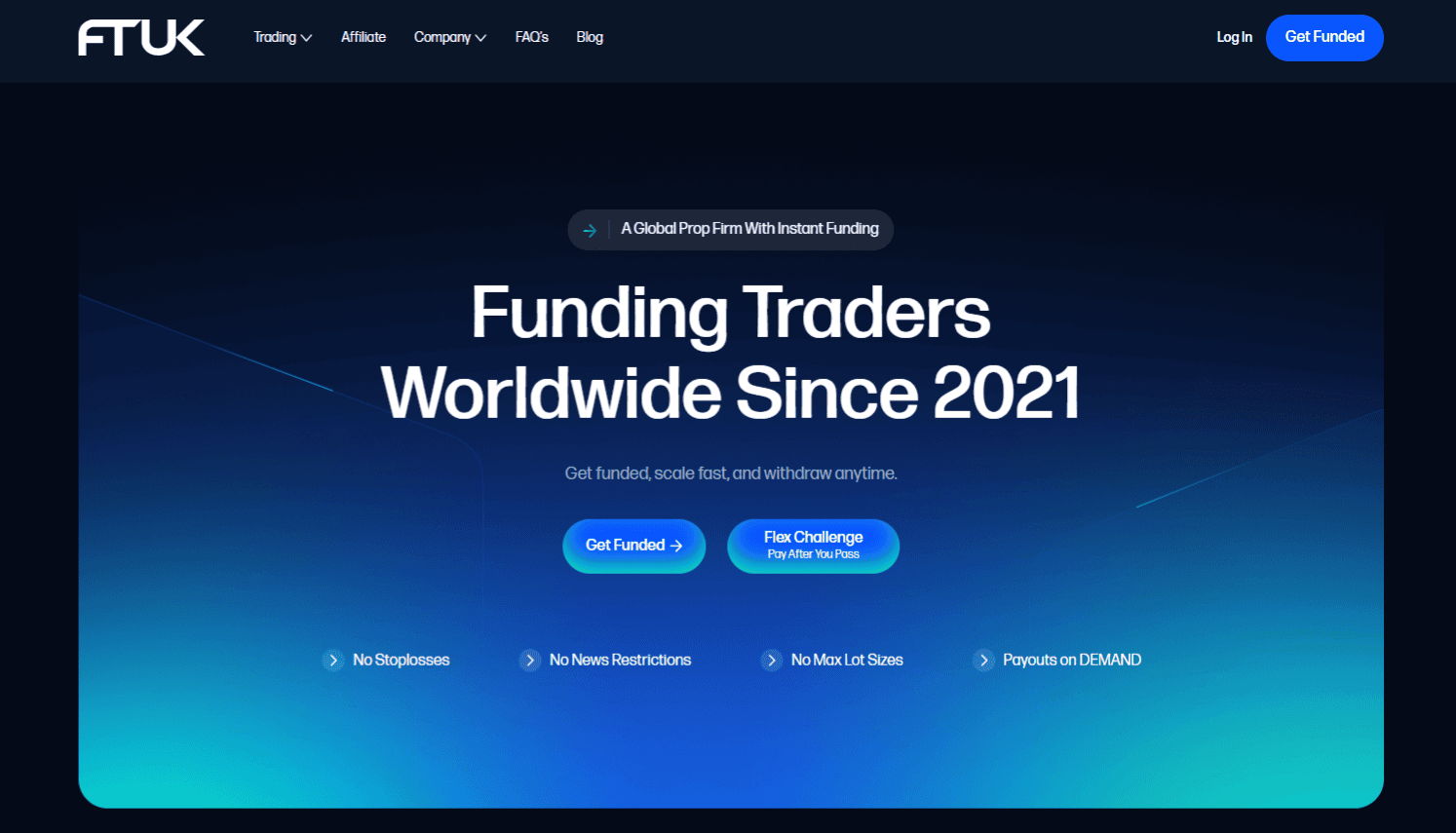
FTUK is the only firm here that puts a stopwatch on it, and the number is 30 seconds.
The help centre permits risk management EAs and bots, then sets out what stays off limits whether a robot is involved or not.
That list covers grid trading and Martingale, arbitrage in its hedge, latency and reverse forms, tick scalping, and high-frequency trading, which it pins down as any trade opened and closed inside half a minute. Breach one and the account closes.
A published definition is valuable even when the answer is no. You know where you stand, you can test your strategy against it before paying, and no discretionary judgement waits at the payout stage.
Everything above that floor is unusually open. FTUK advertises no news restrictions, no stop loss requirement and no maximum lot sizes, with payouts on demand and an average payout time of 60 minutes.
The Flex Challenge carries no minimum or maximum trading days and lets you pay after you pass.
Key Features: a published floor of half a minute per round trip; robots welcome above it; nothing blocking you around releases; stop losses left to your discretion; lot sizes uncapped; withdrawals available on request; and a firm operating since 2021 that reports paying out more than $12,000,000 into 133 countries.
Best for: a fast strategy that is fast in intent rather than in milliseconds, where knowing the exact threshold is worth more than an ambiguous permission.
4. Funded Trading Plus
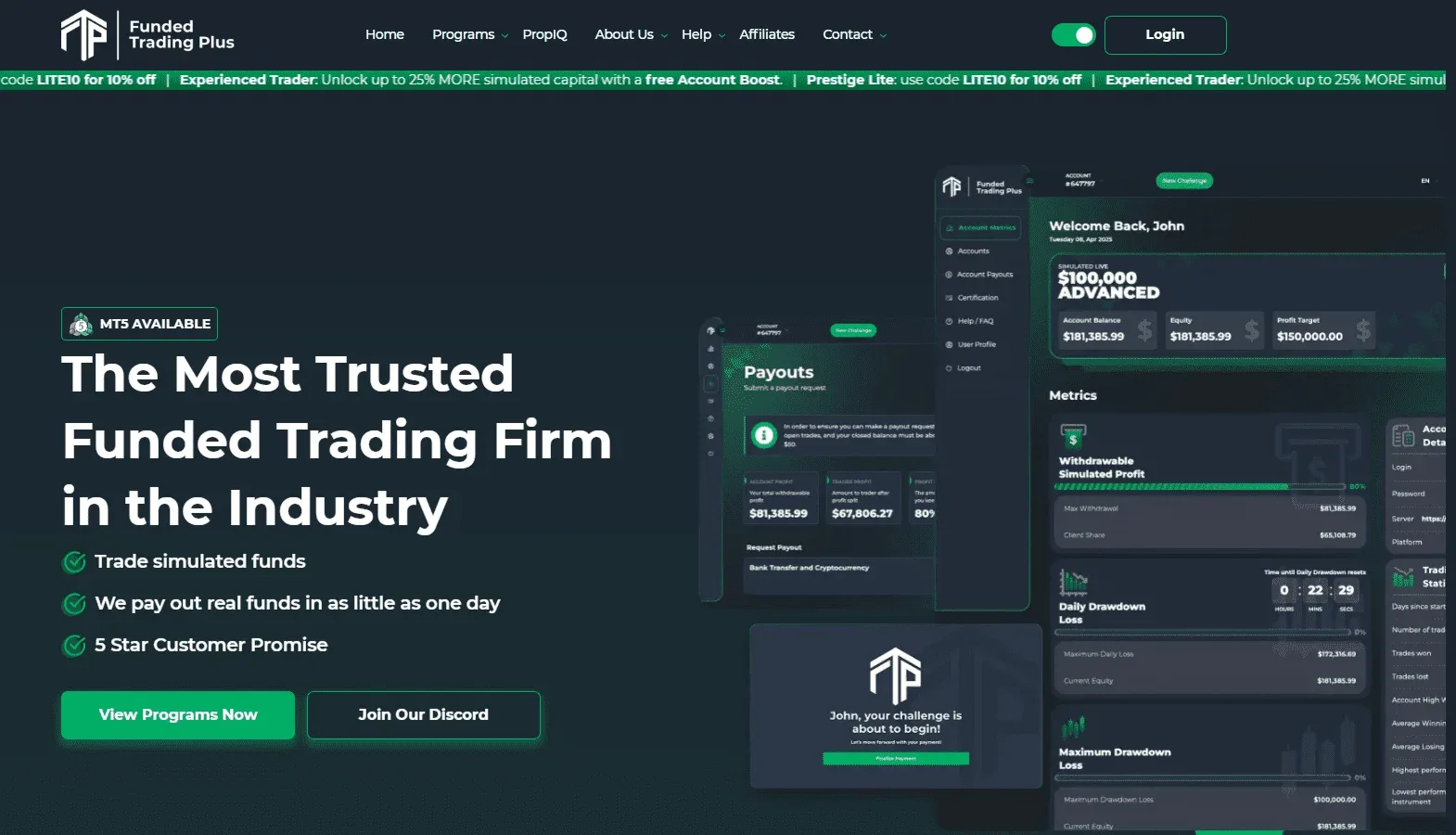
Funded Trading Plus never uses the phrase high-frequency trading anywhere in its programme terms, which changes what you should be reading.
What the terms do prohibit is tick-scalping, alongside abusive practices taking an unrealistic advantage of simulated conditions that would not be possible in real market trading. Excessive risk in a single trade and excessive cumulative risk are named separately.
Nobody here asks who wrote your software or requires you to apply first.
The terms name outside software directly, listing API integrations, Expert Advisors and automated trading programmes, and hand full responsibility to the account holder, with the firm declining liability if any of it freezes, misfires or fails to execute.
The real gate is the Risk Review Policy, which measures margin rather than speed. Reviews trigger at evaluation passes, scaling requests and withdrawals, with automated thresholds running from 75% on a $5,000 account to 55% at $200,000 and above.
Their published example of unacceptable behaviour is a trade using 90% of margin for roughly ten seconds, called a coin-flip. The acceptable version uses modest margin and runs about half an hour.
Key Features: nothing in the terms banning HFT by name; robots and API connections usable without applying; tick-scalping ruled out; a review that examines margin instead of clock speed; releases open to trade; the 1-Step Express carrying no consistency requirement; and an account that expires after 30 days without a trade.
Best for: an automated strategy that trades frequently at sensible position size, since the review here asks how much you risked rather than how quickly you traded.
5. Bulenox

Bulenox says yes to the tooling and draws its line at volume. On the tooling the FAQ leaves no doubt: copiers, algorithms and bots all pass.
Two strings attach. Reaching Rithmic by way of composite software or an outside API adds $100 to the monthly bill.
And whatever runs has to be something you built for your own use alone, which shuts out anything rented, shared, sold commercially or handed around publicly.
Speed enters in the Terms of Use, in the section headed Algorithms and Auto Trading.
Abusing the service is prohibited, and the wording names scalping algorithms and the DTC Protocol Bridge API among the examples, along with any algorithm used to fire off hundreds or thousands of quick trades in succession.
Reckless trades placed into disorderly markets to profit from missing execution sit on the same list. Suspicion of abuse allows a profit claim to be turned down.
The shape, then: your own bot may run at whatever pace a real strategy needs, but not as a churning machine.
Key Features: automation of every kind welcome; $100 monthly on top for outside Rithmic connections; your own builds only; releases entirely open with nothing blacked out; no floor or ceiling on trading days; profit retention reaching 90%; and every cent of your first $10,000 withdrawn.
Best for: a futures algo trader running code they wrote at a moderate pace, especially one who also values trading releases without a calendar.
Comparison: Prop Firms That Allow High-Frequency Trading (HFT)
| Firm | Position on HFT | The measurable boundary |
| FunderPro | Allowed with limits | Fairness conditions, no latency exploitation |
| FunderPro Futures | Prohibited in the terms | HFT systems and AI-driven mass entry barred |
| FTUK | Prohibited, defined | Trades opened and closed within 30 seconds |
| Funded Trading Plus | No HFT prohibition published | Tick-scalping barred, margin reviewed |
| Bulenox | Bots yes, mass churn no | No hundreds or thousands of rapid trades |
Reading a Firm’s HFT Rule Properly
Three habits save money here.
Look for a number. FTUK‘s 30 seconds and Tradeify’s ten-second holding ratio are the exception rather than the rule, and a firm that publishes one has removed the argument before it starts.
Where no number exists, the rule is discretionary.
Read the terms, not the marketing. FunderPro Futures allows automation on its FAQ pages and prohibits HFT in clause 13.
Bulenox permits bots in its FAQ and restricts mass rapid trading in its Terms of Use. The binding document is the one that decides a payout dispute.
Separate speed from exploitation. Almost every rule on this page is aimed at latency arbitrage, tick scalping and price-feed exploitation rather than at frequency itself.
A fast strategy that takes ordinary market risk is usually fine; a fast strategy that only works because of a simulated fill is not.
Frequently Asked Questions
Which Prop Firm Actually Allows HFT?
FunderPro states it directly: HFT and automated bots are allowed during the Funded Account Challenge, provided they operate fairly and within platform guidelines, with prohibitions covering exploitation rather than speed.
What Counts As High-Frequency Trading At A Prop Firm?
Definitions vary widely. FTUK defines it as opening and closing trades within 30 seconds.
Blueberry Funded describes it as firing large volumes of orders in very short windows. The5ers calls it trade durations measured in a few seconds or less.
Always check the specific firm’s wording.
Is Scalping The Same As HFT?
No, and several firms permit one while barring the other.
FunderPro allows scalping outright, FTUK permits fast trading above its 30-second floor while prohibiting tick scalping, and Funded Trading Plus bars tick-scalping without restricting frequency generally.
Do These Firms Allow Trading Bots As Well?
All five permit automation in some form. FunderPro allows EAs on MT5, TradeLocker and cTrader.
FTUK allows risk management EAs and bots. Funded Trading Plus permits EAs and API integrations.
Bulenox permits user-built bots and copiers. FunderPro Futures permits third-party EAs where you own the source code.
Why Do Prop Firms Restrict Very Fast Trading?
Because evaluations run in simulated environments, and the fastest strategies can profit from the fill engine rather than from the market.
MyFundedFutures and TradeDay both say this openly, noting that such approaches perform well in evaluation and lose money once routed to live markets.
Does A Firm Without An HFT Rule Mean HFT Is Allowed?
Not reliably.
Funded Trading Plus publishes no HFT prohibition, but its terms bar tick-scalping and its Risk Review Policy examines margin usage at every payout, so a very fast, heavily leveraged strategy can still be rejected under a different clause.