

TradingView is the charting platform most traders actually live in, so it is no surprise people want a funded account they can run from it. The catch is that “works with TradingView” means two very different things in this industry.
Some firms let you place and manage trades natively from TradingView itself, using your funded credentials.
Others simply build TradingView’s charts into their own platform, so you get the charting experience without executing from TradingView.
Both are useful, but only one lets you trade without leaving the platform you know.
Prop Firms That Use TradingView
Below are seven prop firms that use TradingView, with exactly what kind of support each one gives you.
1. Hola Prime

TradingView support: charting, inside TradeLocker. Hola Prime runs on TradeLocker, which is powered by TradingView’s charting library, so the charts feel familiar even though execution happens in TradeLocker rather than on TradingView itself.
As a firm it is one of the more flexible options going, with account sizes starting at just $5,000 and running to $300,000, and no daily loss limit to trip over.
Key Features:
- TradingView charting built into the TradeLocker platform.
- Accounts from $5,000 up to $300,000.
- One-Step Prime challenge with a 6% target and a 4% trailing drawdown.
- No daily loss limit, 90% profit split, fast payout processing.
Pros: familiar TradingView charts, a genuinely small entry account, no daily loss limit.
Cons: you cannot execute from TradingView itself, and entry pricing shifts with promotions.
2. Eightcap Challenges
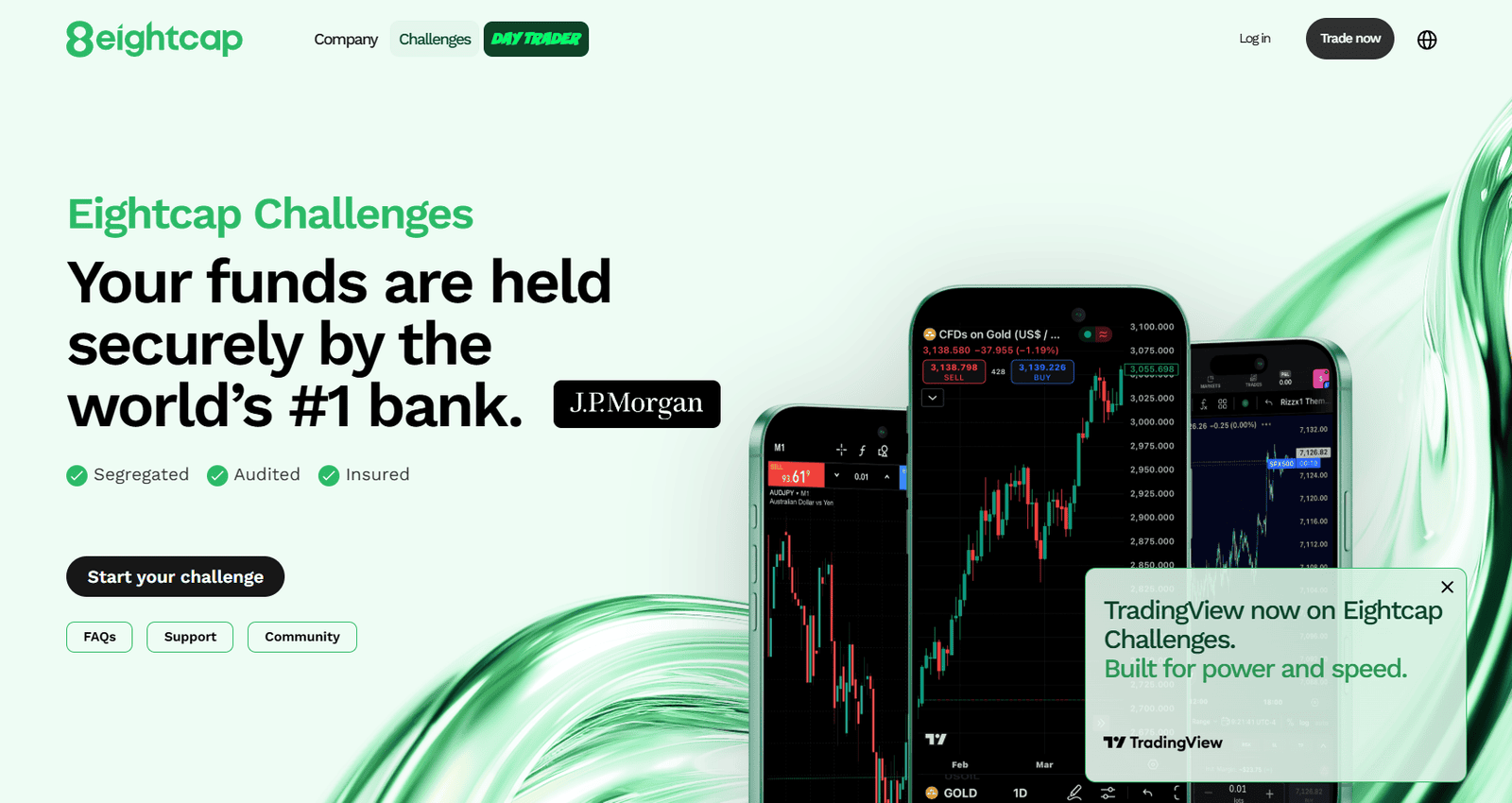
TradingView support: native trade-through. This is the real thing. Eightcap is a regulated broker in its own right, licensed with ASIC, the FCA, and CySEC and operating since 2009, so its challenge accounts connect straight to TradingView with no third-party broker in the middle. That is why the integration is seamless where others need a bridge.
Key Features:
- Native TradingView execution, plus MT4, MT5, and TradeLocker.
- One-Step (10% target) and Two-Step (9% then 5%) evaluations.
- Account sizes from $25,000 to $200,000.
- 80% profit split, payouts every 14 days, with an add-on that cuts it to 3 days.
Pros: a genuine broker-grade TradingView connection, real regulatory backing, and a long operating history.
Cons: the 80% split sits just under the 90% some rivals advertise, and entry pricing is above the budget firms.
3. Darwinex Zero

TradingView support: native, with one limit. Darwinex Zero also lets you trade through TradingView directly, though only on forex, indices, and commodities. Its stock and ETF range is MT5-only, so equity traders lose the TradingView route.
It is also a completely different model from everything else here. Rather than buying a challenge, you pay a small monthly subscription, roughly 38 euros, to build a verified track record. Perform well and the firm allocates you real capital.
Key Features:
- Native TradingView trading on forex, indices, and commodities.
- A subscription of about 38 euros per month instead of a challenge fee.
- Backed by Darwinex, a regulated broker.
- You keep 15% of the profit generated on allocated capital.
Pros: no per-attempt fees, a regulated parent, and a genuine TradingView connection.
Cons: stocks and ETFs are MT5-only, and the 15% allocation share works on a different basis to a standard prop split.
4. Trade The Pool

TradingView support: charting and alerts only. Trade The Pool connects to TradingView through a third-party automation layer, SignalStack, which turns alerts you set on TradingView charts into live orders. It works, but it is a bridge rather than native execution.
The firm itself is the stock specialist of this group, built for US equities rather than forex, and run by the team behind The5ers.
Key Features:
- TradingView alerts routed to orders via the SignalStack bridge.
- A stock-focused lineup covering equities, ETFs, and ETNs.
- Short selling built in, including IPOs from day one.
- Day accounts from $59, with a 70/30 split rising to 80%.
Pros: genuine stock exposure, strong shorting tools, and a proprietary platform with Level 2 data.
Cons: TradingView execution needs a paid third-party bridge, and positions are auto-liquidated near the close.
5. FundedNext

TradingView support: charting and analysis. FundedNext piloted native TradingView execution and then paused it, so for now you chart in TradingView and execute on MT5 or one of its other platforms. Worth watching, since the groundwork is clearly laid.
Everything else about the firm is heavyweight: more than $300 million paid to traders and one of the largest independent review bases in prop trading.
Key Features:
- TradingView for analysis, execution on MT4, MT5, cTrader, or Match-Trader.
- Four Stellar models, including a no-evaluation Instant route.
- Accounts from $6,000 to $200,000.
- An 80% baseline split, rising toward the advertised 95% ceiling with a paid upgrade.
Pros: a proven payout record, wide model choice, and no consistency rule on its CFD models.
Cons: no TradingView execution for now, and the 95% headline comes with a paid add-on.
6. FXIFY

TradingView support: native trade-through. FXIFY added genuine TradingView trading in late 2025 through a partnership with Alchemy Markets, letting you open, manage, and close positions inside TradingView with your FXIFY login. For a challenge-based firm, that is a strong offering.
Key Features:
- Native TradingView execution, plus MT4, MT5, and DXtrade.
- Five routes in, including One Phase, Two Phase, Instant Funding, and Lightning.
- Two-Phase accounts from around $199 at the $25,000 size.
- Profit split reaching up to 90%.
Pros: true in-platform trading, several ways to qualify, and a high split ceiling.
Cons: rules differ noticeably between the five programs, so read the one you pick carefully.
7. FunderPro

TradingView support: charting, inside TradeLocker. Like Hola Prime, FunderPro delivers TradingView through TradeLocker, where the charting is integrated into the platform itself. You get the charts, not standalone TradingView execution.
The draw here is the rule set: static drawdown rather than trailing, which is far kinder when you give back part of a winning run.
Key Features:
- TradingView charting integrated into TradeLocker, plus MT4 and MT5.
- Fast Track, Regular, and Swing programs across $5,000 to $200,000 accounts.
- Static maximum loss rather than a trailing drawdown.
- Biweekly payouts with a split reaching up to 90%.
Pros: a forgiving static drawdown, wide account range, and one-time pricing.
Cons: no native TradingView execution, and no crypto in the instrument list.
TradingView Support Compared
| Firm | TradingView support | Execution platform | Standout |
| Hola Prime | Charting via TradeLocker | TradeLocker | $5K accounts, no daily loss limit |
| Eightcap Challenges | Native trade-through | TradingView, MT4/MT5 | Regulated broker since 2009 |
| Darwinex Zero | Native (not stocks) | TradingView, MT5 | Subscription, not a challenge |
| Trade The Pool | Alerts via SignalStack | Proprietary platform | Real stock trading |
| FundedNext | Charting only | MT5, cTrader | $300M+ paid to traders |
| FXIFY | Native trade-through | TradingView, MT4/MT5 | Five ways to get funded |
| FunderPro | Charting via TradeLocker | TradeLocker, MT4/MT5 | Static drawdown |
How to Pick
If trading inside TradingView is non-negotiable, your shortlist is short: Eightcap Challenges, FXIFY, and Darwinex Zero.
Eightcap is the most conventional prop route of the three, FXIFY gives the most ways to qualify, and Darwinex Zero suits anyone who would rather build a track record than buy a challenge.
If you only want TradingView’s charts and are happy executing elsewhere, the field opens up.
Hola Prime and FunderPro give you that experience inside TradeLocker with genuinely trader-friendly rules, and FundedNext brings the strongest payout record of the group.
One practical note: integrations in this space change often, and FundedNext’s paused rollout shows how quickly. Confirm the current setup at signup rather than assuming it still works the way a review says.
Frequently Asked Questions
Which Prop Firms Let You Trade Directly on TradingView?
Eightcap Challenges, FXIFY, and Darwinex Zero offer genuine trade-through, meaning you place and manage orders inside TradingView using your funded account credentials.
Is TradeLocker The Same As TradingView?
No. TradeLocker is a separate trading platform that uses TradingView’s charting library, so the charts look and feel familiar. You are still executing in TradeLocker, not on TradingView itself.
Can I Use TradingView Alerts to Trade a Funded Account?
Sometimes. Trade The Pool supports this through the SignalStack bridge, which converts your TradingView alerts into live orders. It is a paid third-party layer rather than a built-in feature.
Why Did FundedNext Stop Its Trading View Execution?
The firm piloted native execution and paused it over platform load, so TradingView currently serves for charting while trades run on MT5 or its other platforms. No relaunch date has been announced publicly.